
When a child doesn’t respond to their name or seems to ignore sounds, it’s easy to brush it off as being distracted. But in some cases, it could be something more serious-pediatric hearing loss. Unlike adult hearing loss, which often develops slowly, hearing problems in children can quietly derail speech, learning, and social growth if not caught early. The good news? We now have the tools to find and fix most cases before they cause lasting damage-if we act fast.
Why Early Screening Matters More Than You Think
Every year in the U.S., about 3 in 1,000 babies are born with hearing loss. That’s more than 12,000 newborns annually. Many of these cases have no obvious signs at birth. No family history. No visible symptoms. That’s why universal newborn hearing screening became standard practice in the early 2000s. Today, 94% of U.S. newborns get screened before leaving the hospital. The goal is simple: find hearing loss by 1 month, confirm it by 3 months, and start intervention by 6 months. Why this timeline? Because the brain’s ability to learn language peaks in the first year of life. Children identified before 6 months develop spoken language skills at the same rate as hearing peers 60-70% of the time. Those diagnosed after 12 months? Only 20-30% reach normal language levels. Screening isn’t a one-time event. The American Academy of Pediatrics recommends follow-up checks at ages 4, 5, 6, 8, and 10, plus once during early adolescence (11-14), again in mid-teens (15-17), and once more before adulthood (18-21). Why? Because hearing loss doesn’t always show up at birth. Infections, loud noise, or even repeated ear infections can cause loss later.What Causes Hearing Loss in Children?
Pediatric hearing loss falls into two main buckets: congenital (present at birth) and acquired (happens after birth). About half of all cases are genetic. Mutations in the GJB2 gene alone account for half of those inherited cases. If a child’s parent or sibling has childhood hearing loss, the risk jumps significantly. Another 25% of congenital cases come from infections during pregnancy-especially cytomegalovirus (CMV). It’s the most common non-genetic cause of hearing loss in newborns. Yet, most hospitals don’t test for CMV unless there’s a red flag. Prematurity and low birth weight also raise risk. Babies who spend time in the NICU, especially those treated with certain antibiotics or exposed to high noise levels, are more likely to develop hearing issues. After birth, the biggest culprit is ear infections. By age 3, 80% of kids have had at least one bout of otitis media. Most cause temporary hearing loss-muffled sounds, like listening through cotton balls. But if they keep coming back, they can damage the middle ear long-term. Noise-induced hearing loss is rising fast. One in eight children aged 6 to 19 now has measurable hearing damage from loud headphones, video games, or concerts. And it’s permanent. Once the hair cells in the inner ear die, they don’t grow back. Meningitis is another serious cause. About 30% of children who survive bacterial meningitis lose some or all of their hearing. That’s why follow-up hearing tests are mandatory after recovery.How Screening Works at Different Ages
Screening methods change as kids grow. For newborns, two tests are standard: Otoacoustic Emissions (OAE) and Automated Auditory Brainstem Response (AABR). OAE checks if the inner ear responds to sound. AABR measures how the auditory nerve sends signals to the brain. Both are quick, painless, and done while the baby sleeps. For infants under 6 months, screening results should be reviewed at the first well-child visit. Doctors also check for risk factors: family history, craniofacial abnormalities, or NICU stay. Between 6 months and 3 years, doctors watch for developmental delays. If a child isn’t babbling by 6 months, saying words by 12 months, or combining two words by 24 months, hearing should be tested-even if they passed newborn screening. Starting at age 3, pure-tone audiometry becomes the norm. Kids wear headphones and press a button when they hear a tone. Screening levels are set at 20 dB for 1000, 2000, and 4000 Hz. For older kids, 6000 Hz is added. If they miss two or more frequencies, they’re referred for a full hearing test. Tympanometry is often used too. It checks for fluid behind the eardrum by measuring how the eardrum moves. A reading over 250 daPa in kids over 3, or over 275 daPa in younger kids, signals possible middle ear fluid.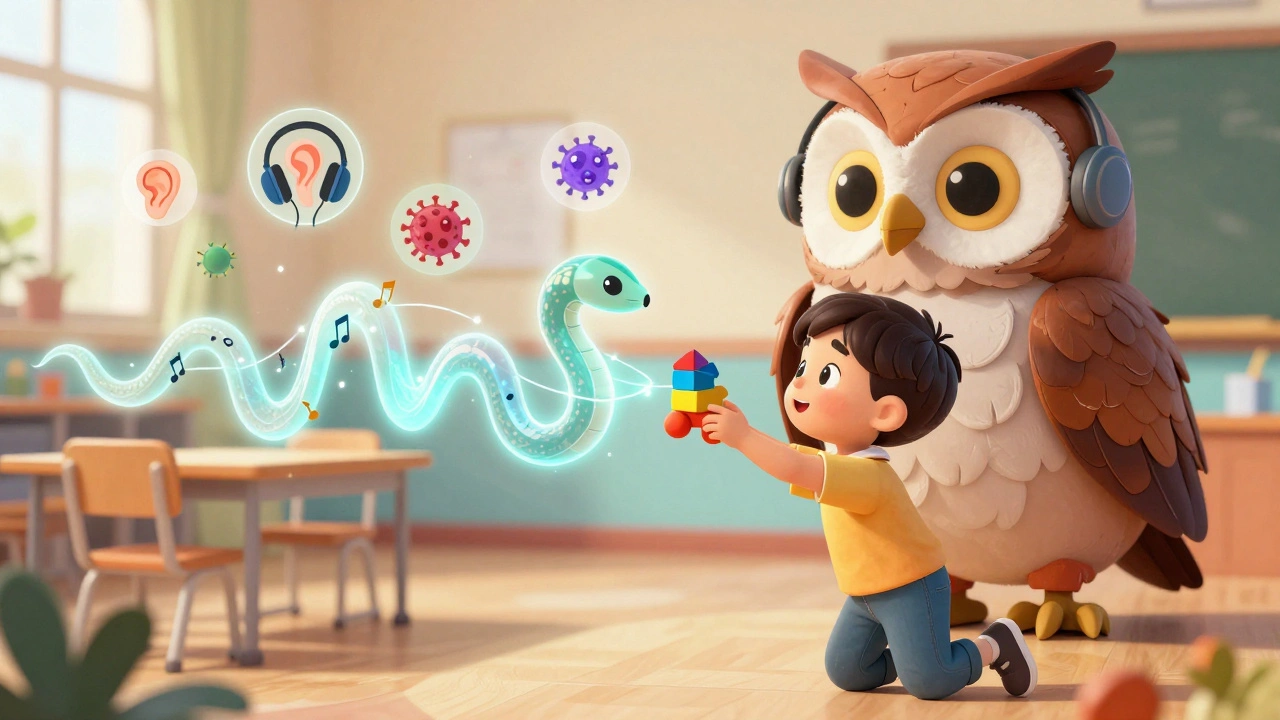
What Happens After a Failed Screen?
Failing a screening doesn’t mean your child is deaf. It means they need a deeper look. About 1 in 10 babies who fail newborn screening turn out to have normal hearing-false positives happen due to fluid, movement, or background noise. But if a diagnostic hearing test confirms permanent hearing loss, intervention must start by 6 months. That’s non-negotiable. Delaying treatment means missing the critical window for brain development. Intervention options depend on the type and degree of loss:- Hearing aids help kids with mild to moderate loss. They improve speech understanding in quiet settings by up to 85%.
- Cochlear implants are for severe to profound loss. Around 60-70% of implanted children develop open-set speech recognition-meaning they can understand speech without lip-reading.
- Assistive listening devices like FM systems help in classrooms by reducing background noise.
- Sign language and bilingual-bicultural education (using ASL and written English) lead to 80% high school graduation rates for deaf children when taught by fluent signers.
- Auditory-verbal therapy trains kids to use hearing, even with hearing aids or implants. When started before 12 months, 65-75% of children reach age-appropriate spoken language.
Who Does What in the Process?
It takes a team. Pediatricians do developmental checks at every visit using tools like PEDS, which catches hearing concerns with 92% accuracy. Nurses and trained technicians often do school screenings. But only audiologists can do full diagnostic evaluations. Speech-language pathologists (SLPs) also play a big role. In 87% of U.S. school districts, SLPs are responsible for hearing screenings. They’re often the first to notice a child struggling to follow directions or mispronouncing words. For families, navigating this system can be overwhelming. That’s why states have Early Hearing Detection and Intervention (EHDI) programs. But performance varies wildly. In Utah, 92.7% of diagnosed infants get services by 6 months. In Mississippi, it’s just 38.2%. And Black and Hispanic children are 23% less likely to get timely care than white children.
Barriers and Breakthroughs
The biggest problem? Loss to follow-up. Nearly 4 in 10 babies who fail newborn screening never get a diagnostic test. Rural families face long drives, lack of specialists, or insurance hurdles. Even when families get referred, paperwork, language barriers, or fear can stall progress. New tech is helping. Telehealth audiology now matches in-person tests with 92% accuracy. Mobile screening units have reached over 15,000 children in underserved areas. Smartphone-based OAE devices are being tested with 95% sensitivity. Even AI is stepping in. New algorithms can interpret audiograms with 98.7% accuracy compared to human audiologists. That could cut wait times and expand access. Looking ahead, universal genetic screening at birth could identify 80% of genetic hearing loss before symptoms appear. Expanded CMV testing for newborns could prevent thousands of cases.What Parents Can Do
You don’t need to be an expert to protect your child’s hearing. Here’s what to do:- Make sure your baby gets screened before leaving the hospital.
- Ask your pediatrician about hearing checks at every well-child visit.
- Watch for red flags: no babbling by 6 months, no words by 12 months, not responding to name, turning up the TV volume.
- Limit headphone use. Keep volume below 60% and time under 60 minutes per day.
- Get ear infections treated quickly and follow up with hearing tests if they recur.
- If your child has a known risk factor-like prematurity or family history-request a baseline hearing test even if they passed newborn screening.
Early Action Changes Everything
Hearing loss in children isn’t just about not hearing. It’s about missing out on language, connection, and opportunity. But with today’s tools, we can prevent most of those losses-if we act before the child’s sixth month. The science is clear. The systems are in place. The only thing missing is urgency. Don’t wait for a child to fail school. Don’t wait for them to withdraw socially. Don’t wait for someone else to notice. If something feels off about how your child responds to sound, trust your gut. Ask for a hearing test. Early detection isn’t just medical-it’s life-changing.How common is pediatric hearing loss?
About 3 in every 1,000 babies are born with hearing loss. That’s roughly 12,000 newborns each year in the U.S. Many cases are not obvious at birth, which is why universal newborn screening is so important.
Can hearing loss in children be reversed?
Some types can be temporary. For example, hearing loss caused by ear fluid from infections often clears up with treatment. But sensorineural hearing loss-damage to the inner ear or nerve-is permanent. That’s why early intervention with hearing aids, cochlear implants, or therapy is critical to help children develop language skills even with permanent loss.
What are the signs of hearing loss in toddlers?
Watch for: not responding to their name, delayed speech (no words by 12 months), speaking very softly, turning up the TV volume, not reacting to loud noises, or seeming to hear some sounds but not others. If you notice any of these, ask your pediatrician for a hearing screening.
Is hearing screening required by law?
Yes. All 50 U.S. states and territories have laws requiring newborn hearing screening. Many also require screening before kindergarten and during school years. For example, Minnesota requires screening before kindergarten, and Kansas requires screening within five days of birth.
What should I do if my child fails a school hearing test?
Don’t ignore it. Request a full diagnostic hearing evaluation by an audiologist within a few weeks. School screenings are just a first step-they can miss subtle losses or give false positives. A full test will confirm whether there’s a problem and what kind of support your child needs.
Can loud music damage my child’s hearing?
Absolutely. One in eight children aged 6 to 19 already has noise-induced hearing loss from headphones, video games, or concerts. The damage is permanent. Follow the 60/60 rule: no more than 60% volume for no longer than 60 minutes at a time. Use noise-canceling headphones to reduce the need for high volume.
How effective are cochlear implants for children?
Cochlear implants are highly effective for children with profound hearing loss. About 60-70% of children who receive them before age 2 develop open-set speech recognition-meaning they understand spoken language without lip-reading. Success depends on early implantation and consistent therapy.
Are there free or low-cost hearing services for families?
Yes. Under IDEA Part C, all children under 3 with diagnosed hearing loss are eligible for free early intervention services, including evaluations, hearing aids, and therapy. Many states also have Medicaid programs that cover hearing aids and cochlear implants. Ask your pediatrician or local health department for referrals.


