
Acid-Reducing Medication Interaction Checker
Check Medication Interactions
Enter your medications to see if they interact with acid-reducing drugs like omeprazole, famotidine, or ranitidine.
Most people think taking an acid-reducing medication like omeprazole or famotidine is harmless-just a quick fix for heartburn. But what if that pill you take for indigestion is quietly sabotaging your blood pressure medicine, your cancer drug, or even your HIV treatment? The truth is, acid-reducing drugs don’t just calm your stomach. They change how your body absorbs other medications, sometimes with dangerous results.
How Acid-Reducing Medications Work
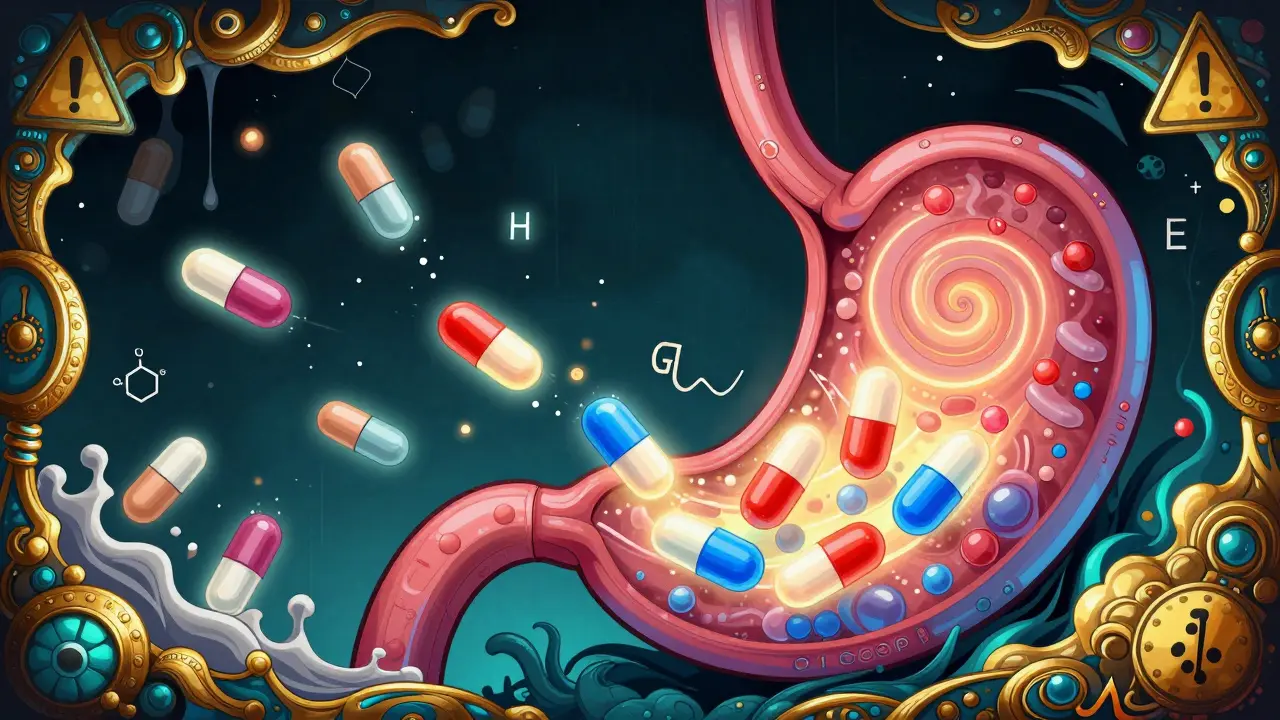
Acid-reducing medications fall into two main categories: proton pump inhibitors (PPIs) like omeprazole, esomeprazole, and lansoprazole; and H2 receptor antagonists (H2RAs) like ranitidine and famotidine. Both lower stomach acid, but they do it differently. PPIs shut down the acid-producing pumps in your stomach lining for up to 24 hours. H2RAs block histamine signals that tell your stomach to make acid, but their effect lasts only 8 to 12 hours.Normal stomach acid has a pH between 1.0 and 3.5-strong enough to break down food and kill bacteria. When you take a PPI, that pH can jump to 4.0 or higher and stay there for most of the day. That sounds good if you have ulcers or GERD. But it’s a problem for dozens of other drugs that need acid to dissolve properly before they can be absorbed.
Why pH Changes Break Drug Absorption
Most drugs are either weak acids or weak bases. Their ability to dissolve-and therefore be absorbed-depends on the pH around them. This isn’t guesswork. It’s basic chemistry, explained by the Henderson-Hasselbalch equation.Weakly basic drugs (pKa above 7) need acid to stay dissolved. In a low-pH stomach, they’re ionized and soluble. But when acid is suppressed, these drugs stay in their non-ionized form. They don’t dissolve well. They sit in the stomach like chalk in water. Even if they eventually reach the small intestine-where most absorption happens-they’ve already failed to dissolve properly. The result? Less drug gets into your bloodstream.
Think of it like this: your body can’t absorb a pill if it doesn’t dissolve first. And for some drugs, that dissolution only happens in acid.
Drugs Most at Risk
Not all drugs are affected. But about 25 to 50% of the top 200 prescribed medications in the U.S. are weak bases that could be impacted. Here are the ones that cause the most real-world problems:- Atazanavir (HIV treatment): When taken with a PPI, its absorption drops by 74% to 95%. Patients have gone from undetectable viral loads to over 12,000 copies/mL after starting omeprazole.
- Dasatinib (leukemia drug): Absorption drops by about 60%. A 2023 study found patients on PPIs had 37% higher rates of treatment failure.
- Ketoconazole (antifungal): Absorption falls by 75%. It becomes practically useless when combined with PPIs.
- Dasiglucagon (for low blood sugar): This is one of the few exceptions. It’s a weak acid, so higher pH slightly increases absorption-but only by 15-20%, and it rarely causes issues.
The FDA has flagged these 12 high-risk drugs and requires manufacturers to include warnings. But many doctors still don’t check for these interactions. A Reddit thread from January 2024 had multiple users describing how their HIV treatment failed after starting Prilosec. One wrote: “My infectious disease specialist said this is a classic interaction we test for in pharmacology.”
PPIs vs. H2 Blockers: Which Is Worse?
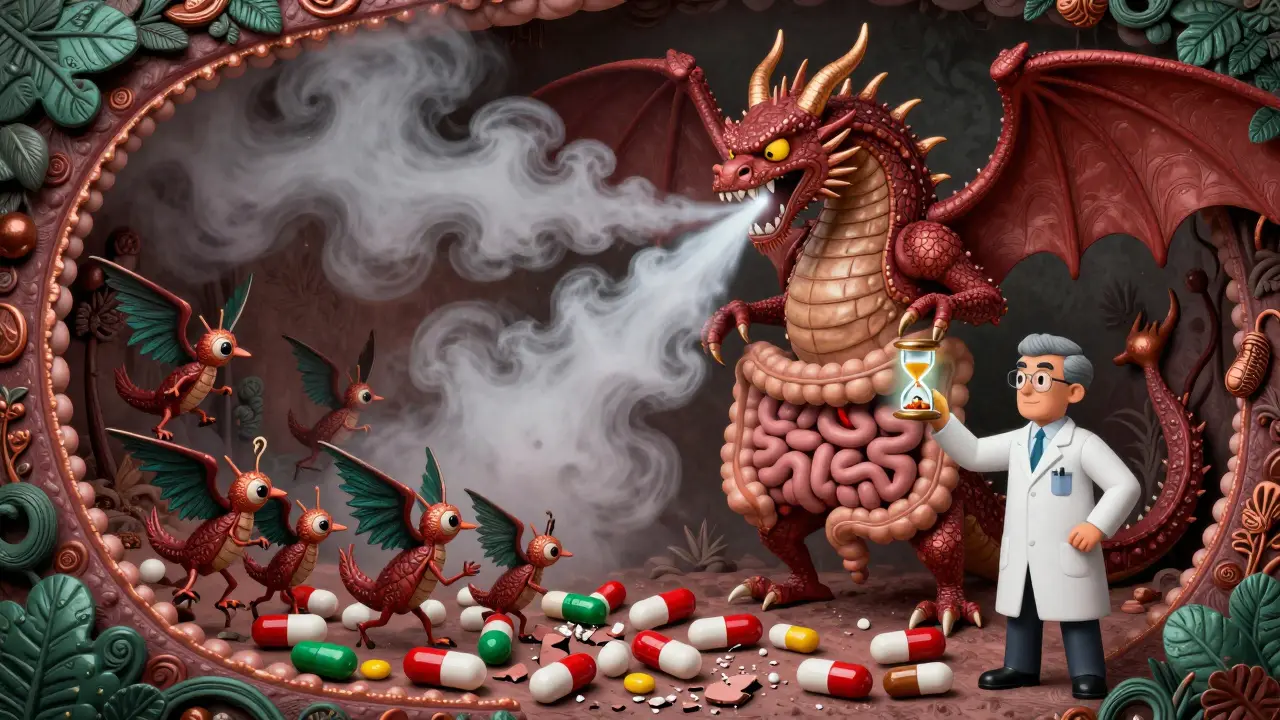
Not all acid reducers are equal. PPIs are far more dangerous when it comes to drug interactions.PPIs keep the stomach pH above 4 for 14 to 18 hours a day. H2RAs do it for only 8 to 12 hours. That extra 6 hours of low acidity makes a big difference. A 2024 study in JAMA Network Open found PPIs reduce absorption of pH-dependent drugs by 40-80%, while H2RAs reduce it by 20-40%.
Even worse, PPIs are often taken long-term. About 15% of adults in the U.S. use them daily-even though studies show 30-50% of those users don’t actually need them. The American College of Gastroenterology says this inappropriate use causes 15,000 to 20,000 preventable therapeutic failures every year.
What About Enteric Coatings and Extended-Release Pills?
You might think enteric-coated pills are safe because they’re designed to dissolve in the intestine, not the stomach. But here’s the catch: if stomach acid is too low, the coating can dissolve too early. Instead of waiting until it reaches the small intestine, the pill breaks open in the stomach where it shouldn’t. That can lead to degradation of the drug or even stomach irritation.Extended-release formulations are less vulnerable because they release slowly over time. But they’re not immune. If the drug needs acid to dissolve in the first place, even a slow release won’t help if the initial dissolution fails.
Real-World Consequences
This isn’t theoretical. The FDA’s Adverse Event Reporting System recorded 1,247 cases of therapeutic failure linked to acid-reducing drugs between 2020 and 2023. The top three culprits? Atazanavir, dasatinib, and ketoconazole.One patient on Drugs.com reported: “My doctor didn’t tell me Nexium would interfere with my blood pressure meds-my readings were consistently 20 points higher until we figured out the interaction.”
On the flip side, there are success stories. A 2022 study in the Journal of Clinical Oncology showed that when patients with chronic myeloid leukemia took dasatinib 12 hours before their PPI, therapeutic levels were restored in 85% of cases. Timing matters.
How to Protect Yourself
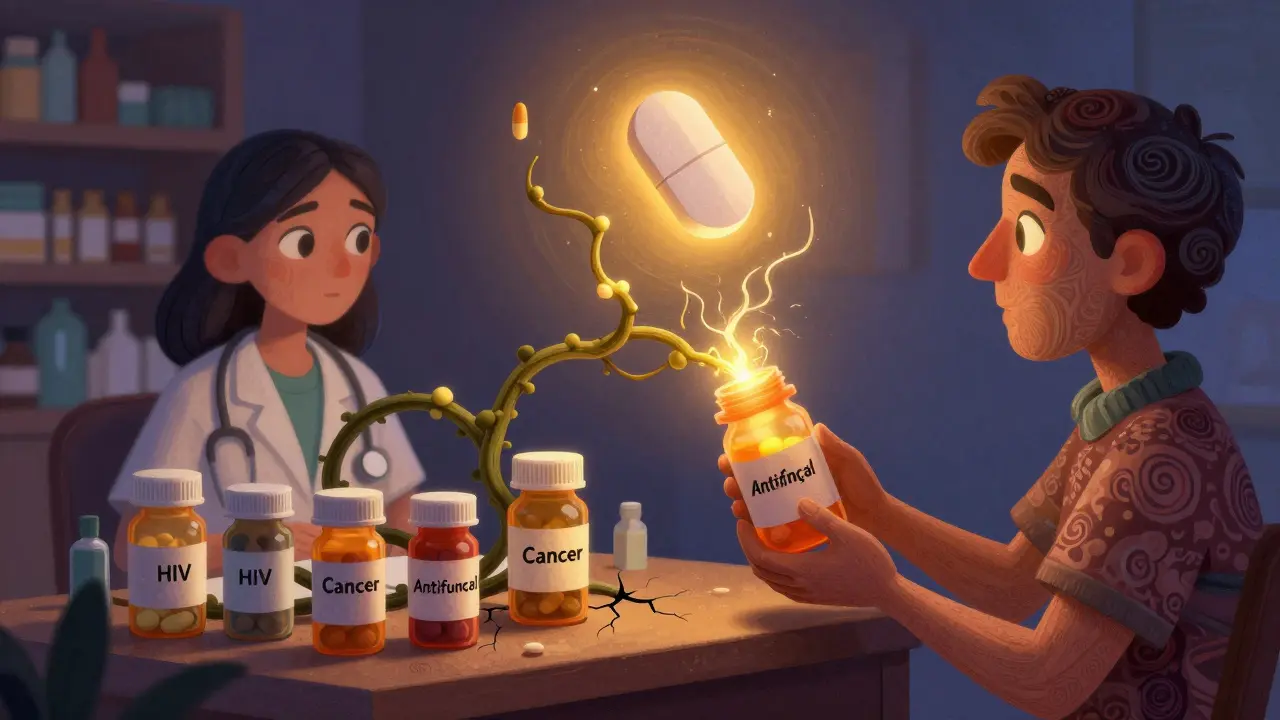
If you’re on an acid-reducing medication and take other prescriptions, here’s what to do:- Ask your pharmacist if any of your drugs are affected. Pharmacists are trained to spot these interactions. One 2023 study showed pharmacist-led reviews cut inappropriate ARA co-prescribing by 62%.
- Check the label. If your drug has a warning about “avoid with proton pump inhibitors,” take it seriously.
- Try staggered dosing. For weak bases, take the drug at least 2 hours before the acid reducer. It won’t fix everything, but it can reduce the interaction by 30-40%.
- Consider alternatives. If you need heartburn relief occasionally, antacids like Tums or Maalox are safer-they work fast and don’t last long. Just take them 2-4 hours apart from your other meds.
- Ask if you still need the acid reducer. The American Gastroenterological Association recommends deprescribing PPIs in up to half of long-term users. Many people take them for years without a real diagnosis.
What’s Changing in 2026?
Regulators are catching up. The FDA now requires drugmakers to test new medications across a pH range of 1.0 to 7.5 before approval. They’re also pushing for AI tools to predict interactions. Google Health’s prototype system, tested in 2024, correctly predicted 89% of acid-reducing drug interactions.Pharmaceutical companies are responding too. About 37% of new drugs in development now use delivery systems designed to avoid pH dependence. That’s up from just 8% five years ago.
Electronic health records now flag dangerous combinations. Epic Systems reports 78% of doctors follow their alerts. But that still means 1 in 5 miss the warning.
Bottom Line
Acid-reducing medications aren’t harmless. They’re powerful tools-but they’re not just for your stomach. They change how your whole body handles other drugs. If you’re on one of these medications and take anything else regularly, don’t assume it’s safe. Talk to your pharmacist. Ask your doctor if you really need it. And if your treatment suddenly stops working, ask: could this be an interaction?The science is clear. The data is real. And the consequences can be life-altering. You don’t need to stop your acid reducer. But you do need to know what it’s doing to your other meds.
Can acid-reducing medications make my other drugs less effective?
Yes. Proton pump inhibitors (PPIs) and H2 blockers raise stomach pH, which can prevent weakly basic drugs like atazanavir, dasatinib, and ketoconazole from dissolving properly. This reduces how much of the drug enters your bloodstream, potentially leading to treatment failure. For example, atazanavir absorption can drop by up to 95% when taken with a PPI.
Are PPIs worse than H2 blockers for drug interactions?
Yes. PPIs suppress stomach acid more completely and for longer-up to 18 hours a day-compared to H2 blockers, which work for only 8 to 12 hours. Studies show PPIs reduce absorption of pH-dependent drugs by 40-80%, while H2 blockers reduce it by 20-40%. PPIs also carry a higher risk of long-term, unintended consequences because they’re often taken daily for years.
What should I do if I’m on both an acid reducer and another medication?
First, check the labels of all your medications for interaction warnings. Then, talk to your pharmacist-they’re trained to catch these. If the interaction is high-risk (like with atazanavir or dasatinib), ask your doctor if you can stop the acid reducer or switch to an antacid taken 2-4 hours apart. If you must keep both, take the affected drug at least 2 hours before the acid reducer to reduce the interaction.
Do enteric-coated pills avoid these interactions?
Not always. Enteric coatings are designed to dissolve in the small intestine, not the stomach. But if stomach acid is too low, the coating can break down too early-causing the drug to dissolve in the stomach where it might degrade or cause irritation. This is especially risky for drugs that need a specific pH to remain stable.
How common are these drug interactions?
Very. About 25-50% of the top 200 prescribed drugs in the U.S. are weak bases that can be affected. Between 2020 and 2023, over 1,200 adverse events were reported to the FDA linked to these interactions. The most common are with HIV, cancer, and antifungal drugs. And since 15% of U.S. adults take PPIs long-term-even without a clear need-the risk is widespread.
Can I just take my acid reducer at night to avoid the interaction?
Not reliably. PPIs work for up to 24 hours. Even if you take them at night, your stomach pH will still be elevated the next morning when you take your other drug. For H2 blockers, timing helps more-they’re shorter-acting. But for PPIs, the effect lasts too long for simple timing to solve the problem. The only reliable fix is separation (taking the other drug 2 hours before), switching to an antacid, or stopping the PPI altogether.


