

When you’re diagnosed with atrial fibrillation (AFib), the first question isn’t just what is happening in your heart-it’s what should you do next? Two main paths exist: rate control and rhythm control. And both come with one non-negotiable requirement: stroke prevention. This isn’t theoretical. People with AFib are five times more likely to have a stroke than those without it. The choices you make now can affect how you feel today, how long you live, and whether you avoid a life-altering event like a stroke.
What Is Rate Control?
Rate control means accepting that your heart will keep beating irregularly-but making sure it doesn’t beat too fast. The goal? Keep your resting heart rate between 80 and 110 beats per minute. You don’t need to restore a normal rhythm. You just need to slow things down enough so your heart can pump efficiently without straining.This approach uses medications like beta-blockers (metoprolol, atenolol), calcium channel blockers (diltiazem, verapamil), or digoxin. These drugs don’t fix the electrical chaos in your atria. They just block the signals that make your ventricles race. In the RACE II trial, researchers compared strict rate control (under 80 bpm) to lenient control (under 110 bpm). Guess what? Both worked just as well. Fewer hospital stays, similar survival rates, and less risk of side effects with lenient control. That’s why most doctors start here-especially for older patients or those with other health problems.
Rate control is simpler. Fewer drugs. Less monitoring. Lower cost. It’s the go-to for someone who’s 78, has diabetes, and doesn’t feel much from their AFib. If you’re not dizzy, short of breath, or exhausted, why risk the side effects of stronger drugs?
What Is Rhythm Control?
Rhythm control tries to fix the problem at its source: the irregular heartbeat itself. The goal? Get your heart back into normal sinus rhythm-and keep it there. This isn’t just about feeling better. It’s about reducing long-term damage to your heart and lowering your stroke risk over time.There are two ways to do this: drugs or procedures. Antiarrhythmic drugs like amiodarone, flecainide, or dronedarone can restore rhythm, but they come with risks. Amiodarone works well, but it can damage your lungs, liver, or thyroid over time. Flecainide is safer for younger patients without heart disease, but dangerous if you’ve had a heart attack.
Procedures are where things have changed dramatically. Catheter ablation-where a thin tube is threaded into your heart to burn or freeze the spots causing the misfires-used to be risky and often failed. Today, complication rates are under 5%, and success rates for paroxysmal AFib (the kind that comes and goes) are over 70% after one procedure. Electrical cardioversion, a brief electric shock to reset your rhythm, is still used too, especially in emergencies.
The Big Shift: Why Rhythm Control Is Now First-Line for Many
For years, the AFFIRM trial (2002) ruled the field. It showed no difference in death rates between rate and rhythm control. So doctors defaulted to rate control. It was safer, cheaper, easier.But that trial included mostly older patients-average age nearly 70-with long-standing AFib. What if you’re younger? What if you were diagnosed last month?
The EAST-AFNET 4 trial in 2020 changed everything. It studied 2,785 people with early AFib (median diagnosis just under 6 months ago). Half got usual care (rate control + anticoagulation). Half got early rhythm control-drugs or ablation within 12 months of diagnosis. After five years, the rhythm control group had 21% fewer major events: fewer deaths, fewer strokes, fewer heart failure hospitalizations. That’s not a small difference. It’s a 3.9% absolute reduction in bad outcomes. For a 60-year-old with no other heart disease, that’s a game-changer.
The 2023 European Society of Cardiology guidelines now say: early rhythm control should be offered to patients with AFib regardless of symptom severity. That’s huge. It means if you’re under 75 and diagnosed with AFib, rhythm control isn’t a last resort anymore-it’s a strong first option.
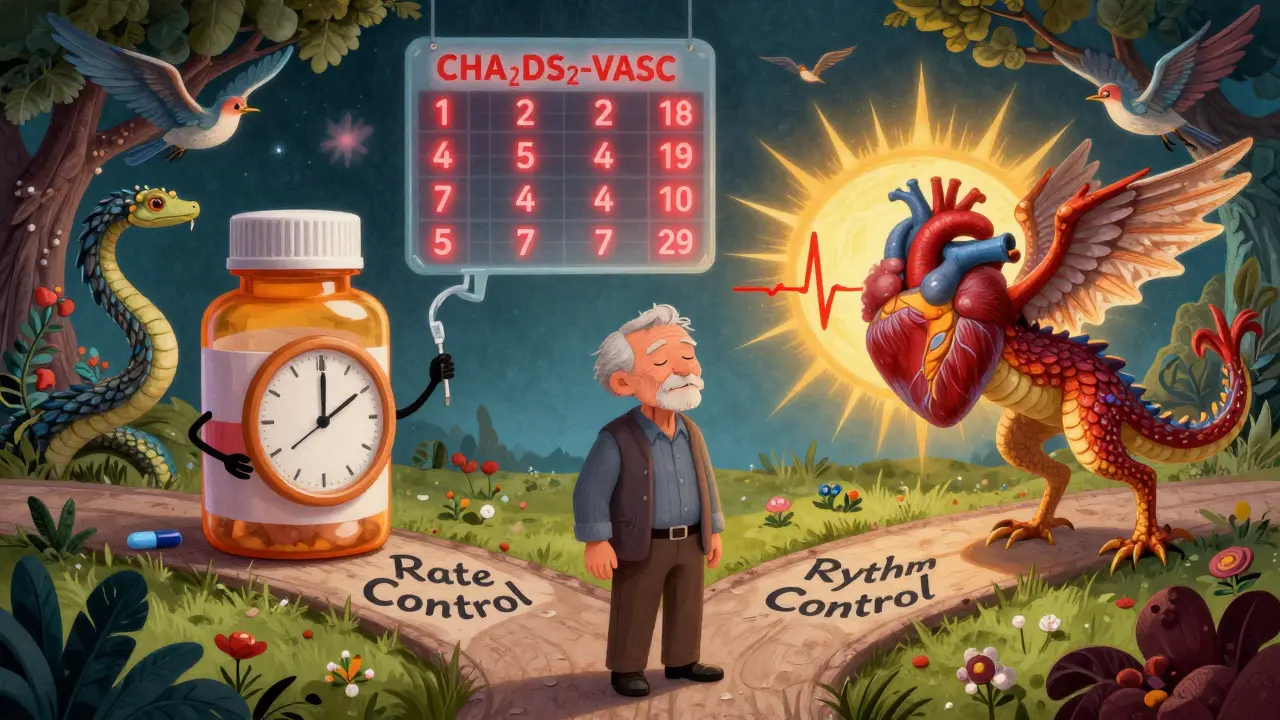
Stroke Prevention: The One Thing Both Strategies Share
Here’s the truth no one talks about enough: whether you choose rate or rhythm control, you still need anticoagulation.AFib doesn’t just make your heart race. It lets blood pool in your left atrium, especially in the left atrial appendage. That pooling leads to clots. And clots that break loose? They travel to your brain. That’s a stroke.
The AFFIRM trial found most strokes happened when patients stopped their blood thinners-or when their INR (a measure of blood-thinning effect) dropped too low. Even if your rhythm is normal, if you have AFib history, your stroke risk doesn’t vanish. That’s why doctors use the CHA₂DS₂-VASc score to decide who needs anticoagulation. A score of 2 or higher? You’re on a blood thinner. Period.
Drugs like apixaban, rivaroxaban, or dabigatran are now standard. They’re safer than warfarin, don’t need constant blood tests, and work better. Don’t skip them. Don’t stop them because you feel fine. Don’t stop them because your rhythm is “fixed.” Your risk stays.
Who Gets Which Strategy?
There’s no one-size-fits-all. But here’s how most cardiologists decide today:- Rate control first: If you’re over 75, have multiple chronic conditions (like kidney disease or COPD), are asymptomatic, or have permanent AFib that’s lasted years. Also if ablation isn’t available nearby.
- Rhythm control early: If you’re under 65, newly diagnosed (within 12 months), have paroxysmal AFib, are very symptomatic (fatigue, palpitations, dizziness), have heart failure, or have a CHA₂DS₂-VASc score of 2 or higher. Especially if you’re active, want to avoid long-term drug side effects, or are worried about stroke.
What about heart failure? The old AF-CHF trial said rhythm control didn’t help. But newer data shows it does-if you have heart failure with preserved ejection fraction (HFpEF), which is common in older women. The Get With The Guidelines registry found rhythm control lowered 1-year death risk in patients over 65 with HFpEF and AFib. So age and heart function matter more than you think.

What’s Next? The Future of AFib Treatment
The tools are getting better. Ablation isn’t just for young, healthy patients anymore. New mapping systems and robotic-assisted catheters make procedures more precise. Drug development is moving too-dronedarone and other newer agents have fewer side effects than amiodarone.The ASSERT II trial, expected to finish in 2025, is testing whether early ablation improves outcomes in AFib patients with HFpEF. If results are positive, rhythm control could become standard even for older patients with preserved heart function.
Personalized care is the future. Genetic testing might soon tell us who responds best to certain drugs. Wearables like Apple Watch and Fitbit are catching AFib earlier than ever-meaning people are being diagnosed before symptoms get severe. That’s the perfect window for rhythm control to work best.
What Should You Do Right Now?
If you’ve just been diagnosed with AFib:- Ask for your CHA₂DS₂-VASc score. If it’s 2 or higher, you need a blood thinner. Don’t argue.
- Ask if you’re a candidate for early rhythm control. If you’re under 75 and have symptoms-even mild ones-push for a referral to an electrophysiologist.
- Don’t assume rate control is “easier.” It’s safer in the short term, but rhythm control may save your life in the long term.
- Get an echocardiogram. Know your heart’s structure and function. That changes everything.
- Don’t wait. The sooner you act after diagnosis, the better rhythm control works.
AFib isn’t just an irregular heartbeat. It’s a warning sign. How you manage it now will shape the next 10, 20, 30 years of your life. The old rules are outdated. The new evidence is clear. For many people, rhythm control isn’t just an option-it’s the smarter path.
Is rhythm control better than rate control for stroke prevention?
Rhythm control doesn’t directly prevent strokes better than rate control. Both require anticoagulation. But rhythm control reduces the overall risk of stroke by lowering the chance of heart failure, cardiovascular death, and hospitalizations-events that often lead to clots. The EAST-AFNET 4 trial showed early rhythm control reduced stroke risk by 21% over five years compared to rate control alone. So while anticoagulants are the direct stroke preventers, rhythm control helps reduce the conditions that make strokes more likely.
Can I stop taking blood thinners if my rhythm is restored?
No. Even if you’re back in normal rhythm, your stroke risk doesn’t disappear overnight. The risk is tied to your history of AFib, not just your current rhythm. Guidelines say you should keep anticoagulation if your CHA₂DS₂-VASc score is 2 or higher, regardless of whether you’re in sinus rhythm. Stopping blood thinners too soon is one of the most common reasons people with AFib have strokes.
Are antiarrhythmic drugs safe long-term?
Some are, some aren’t. Amiodarone is very effective but can cause lung, liver, or thyroid damage over years. Dronedarone is safer but not for people with heart failure. Flecainide and propafenone are good for younger patients without structural heart disease. Your doctor will choose based on your age, heart health, and other conditions. Regular monitoring-blood tests, ECGs, and sometimes lung scans-is key.
Is catheter ablation risky?
Compared to 20 years ago, it’s much safer. Today, serious complications like cardiac tamponade or stroke happen in less than 5% of cases. Most are minor-bruising, temporary heart rhythm changes. Success rates for paroxysmal AFib are 70-80% after one procedure. For persistent AFib, it’s lower, but still effective. The bigger risk is not doing it: leaving AFib untreated leads to heart muscle damage and higher stroke risk over time.
Should I get rhythm control if I’m over 75?
It depends. If you’re healthy, active, and have symptoms, yes-especially if you have heart failure with preserved ejection fraction. But if you have multiple chronic illnesses, limited life expectancy, or live far from an ablation center, rate control is still the better choice. Age alone doesn’t rule you out. Your overall health and goals do.


