
Every year, over 1.3 million medication errors happen in U.S. hospitals alone. Many of these aren’t caused by careless staff-they’re the result of simple mix-ups: the wrong pill, the wrong dose, the wrong patient. And in pharmacies, where hundreds of prescriptions are filled daily, even a 1% error rate can mean dozens of dangerous mistakes. That’s where barcode scanning comes in-not as a fancy gadget, but as a lifesaving checkpoint.
How Barcode Scanning Stops Errors Before They Happen
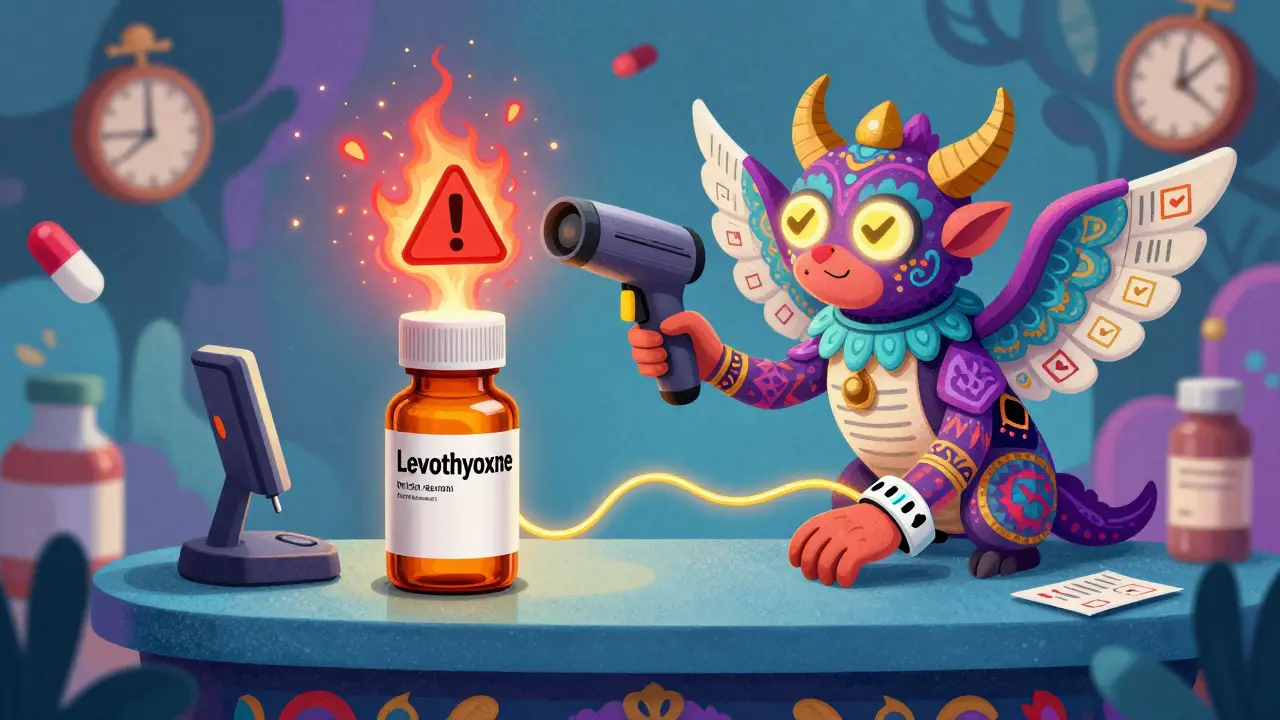
Picture this: a pharmacist reaches for a bottle of levothyroxine. The label says 100 mcg. The prescription calls for 25 mcg. If they’re tired, rushed, or distracted, they might grab the wrong bottle. But if the pharmacy uses barcode scanning, the system won’t let them proceed. The scanner reads the barcode on the patient’s wristband and the barcode on the medication. If they don’t match? An alarm sounds. The error is caught before it leaves the counter. This isn’t science fiction. It’s standard practice in most U.S. hospitals today. The technology works by verifying the five rights: right patient, right medication, right dose, right route, right time. Each step is checked automatically. The system pulls the patient’s record from the electronic health system and compares it to the medication’s unique National Drug Code (NDC). If anything’s off-even if the label looks right-the scanner flags it. A 2021 study in BMJ Quality & Safety found that when barcode systems are used correctly, they prevent 93.4% of potential dispensing errors. That’s not a guess. That’s based on direct observation in real hospitals. One Pennsylvania hospital saw accuracy jump from 86.5% to 97% after installing the system. That’s 10 more correct dispenses per 100 attempts. Multiply that across a busy pharmacy, and you’re talking hundreds of saved patients.What Barcodes Actually Contain
Not all barcodes are the same. Most medications still use 1D linear barcodes-those thin black-and-white lines you’ve seen on grocery items. But these only hold the NDC number, a 10-digit code that identifies the drug, strength, and manufacturer. That’s enough for basic checks, but it doesn’t tell you the lot number or expiration date. That’s why the industry is shifting to 2D matrix barcodes. These look like tiny square patterns of dots, like QR codes. They can store way more data: lot number, expiration, serial number, even the pharmacy that repackaged it. The FDA started encouraging 2D barcodes in 2023, and by 2026, nearly two-thirds of all medications are expected to use them. Why? Because if a drug is recalled, a 2D barcode lets pharmacists instantly trace exactly which bottles are affected. The system connects to the pharmacy’s information system (PIS) and the hospital’s electronic health record (EHR). When you scan, it doesn’t just check the code-it pulls up the patient’s full medication history, allergies, and current prescriptions. If someone’s on warfarin and you try to dispense a new blood thinner, the system will warn you before you even touch the bottle.Why Manual Double-Checks Don’t Cut It
Some pharmacies still rely on the old method: two pharmacists check every prescription. Sounds safe, right? But studies show this only catches about 36% of errors. Why? Because humans get tired. Humans make assumptions. Humans see what they expect to see. In one case, a pharmacist scanned a vial of vancomycin and the system approved it. The label said “1000 mg/10 mL.” But the actual vial inside was labeled “1000 mg/100 mL”-a tenfold overdose. The barcode was correct because the pharmacy had printed the wrong label. The scanner didn’t know the label was wrong. It only knew the code matched the order. That’s why scanning isn’t enough on its own. You still need to look at the medication. That’s the biggest lesson: barcode scanning isn’t a replacement for human judgment. It’s a backup. It’s the safety net that catches the mistakes your eyes might miss. The best systems require both: scan first, then visually confirm the medication matches the label and the order.
Where It Fails-and How Pharmacies Fix It
No system is perfect. Barcodes get smudged. Insulin pens, ampules, and small vials are hard to scan. Some medications come in non-standard packaging with no barcode at all. In emergency situations, staff sometimes skip scanning to save time. ECRI Institute reports that 15% of scanning attempts fail because of damaged or obscured barcodes. And in 29% of cases, staff don’t even scan the medication. In 20% of cases, they don’t scan the patient’s wristband. These aren’t just slips-they’re dangerous workarounds. Leading pharmacies have built fixes into their workflow. Some use special scanning trays for small vials. Others assign a “barcode validation team” to double-check high-risk drugs like insulin, opioids, or chemotherapy. Many hospitals now require that if a barcode won’t scan, the pharmacist must visually verify the medication against the original prescription-and document why they skipped the scan. Training matters too. A 2023 survey found 52% of pharmacy staff had never been properly trained on what to do when a barcode fails. That’s a recipe for disaster. The best pharmacies run monthly drills: “What if the scanner dies? What if the label is missing? What if it’s 2 a.m. and you’re on call?”Real Stories from the Pharmacy Floor
One pharmacist in Ohio told me her system flagged a 10x overdose of levothyroxine. The doctor ordered 50 mcg. The pharmacy dispensed 500 mcg. The barcode matched the order-but the dose was wrong. The system caught it because it compared the dispensed dose to the patient’s typical dose. That’s not just scanning. That’s smart logic. Another tech in Chicago shared how his scanner kept failing on insulin pens. He spent 20 extra minutes every shift trying to get a clean scan. Eventually, his pharmacy bought a new scanner with a brighter light and a magnetic tray. The failure rate dropped by 60%. But not all stories are good. On Reddit, a pharmacy tech wrote: “We had a near-miss last month. A patient got the wrong antibiotic because the barcode on the bottle was torn. We scanned it anyway because we were behind. The patient got sick. We had to call EMS.” These aren’t rare. They’re symptoms of systems that aren’t supported properly. The technology works-but only if the people using it are supported, trained, and not pressured to cut corners.
Adoption Rates and the Future
In U.S. hospitals, 78% now use barcode scanning. That’s up from 42% in 2015. But in community pharmacies? Only 35%. Why? Cost. A full system can run $50,000 to $200,000. Smaller pharmacies can’t afford it. But the savings are real: fewer lawsuits, fewer readmissions, fewer staff hours spent fixing errors. The future is moving fast. Epic Systems released a mobile version in early 2024 that lets pharmacists scan with tablets instead of fixed stations. Scanning speed jumped 22%. Cerner is adding AI to predict which barcodes are likely to fail-and suggests better lighting or angles before the scan even happens. By 2026, most medications will use 2D barcodes. Some companies are testing blockchain-linked barcodes that track a drug from manufacturer to patient. But the core idea won’t change: if you can’t verify it, don’t dispense it.What You Can Do
If you’re a patient: always check your medication before you leave the pharmacy. Does it look right? Does the dose match what your doctor said? If the pharmacist didn’t scan your wristband, ask why. If you’re a pharmacy worker: never skip a scan. If the barcode won’t read, stop. Don’t guess. Don’t rush. Document it. Report it. Your next patient might be counting on you. If you’re a hospital administrator: invest in training. Don’t just buy the scanners-train the people. Review your scanning failure logs monthly. Find the drugs that are most often skipped. Fix the root cause, not just the symptom. Barcode scanning isn’t magic. It doesn’t make errors disappear. But it turns a 1-in-10 chance of a mistake into a 1-in-100 chance. That’s not just efficiency. That’s safety. And in a pharmacy, safety isn’t optional. It’s the job.How effective is barcode scanning at preventing medication errors?
When used correctly, barcode scanning prevents 93.4% of potential dispensing errors, according to a 2021 BMJ Quality & Safety study. In real-world settings, hospitals have seen error rates drop by 65% to 86%. The system catches wrong drugs, wrong doses, and wrong patients by matching scanned data to electronic prescriptions and patient records.
Do all medications have barcodes?
Since 2006, the FDA has required all unit-dose medications in the U.S. to have a barcode with the National Drug Code (NDC). However, some medications-like insulin vials, compounded drugs, or emergency kits-may not have standard barcodes. These require manual verification. By 2026, 65% of medications are expected to use 2D barcodes that hold more safety data.
Can barcode scanning miss errors?
Yes. If a pharmacy prints a wrong label with a correct barcode, the system will approve it. This happened in a case where vancomycin was dispensed in a 10x stronger concentration because the label was misprinted. The barcode matched the order, so the scanner didn’t flag it. That’s why visual verification is still required-scanning is a tool, not a replacement for judgment.
Why do some pharmacists skip scanning?
Common reasons include damaged barcodes, slow scanners, or pressure to speed up during busy hours. A 2023 survey found 41% of pharmacists admit to bypassing scans during emergencies. But skipping scans increases error risk. The best pharmacies train staff to handle failures safely-like using special trays for small vials or pausing to visually confirm instead of forcing a scan.
Is barcode scanning used in community pharmacies?
Only about 35% of community pharmacies in the U.S. use barcode scanning, compared to 78% of hospitals. The main barrier is cost-systems can cost $50,000 or more. But smaller vendors now offer affordable, cloud-based solutions. As 2D barcodes become standard, adoption in community settings is expected to rise, especially with support from pharmacy chains and insurers.


