

When a generic drug hits the market, how do we know it works just like the brand-name version? It’s not about looking at the pill’s color or shape. It’s about two numbers: Cmax and AUC. These aren’t just lab terms-they’re the backbone of whether a generic drug is safe and effective. If these values don’t match up, the drug might not work right-or worse, it could cause harm.
What Cmax Tells You About Drug Absorption
Cmax stands for maximum plasma concentration. Think of it as the highest point a drug reaches in your bloodstream after you swallow it. This number tells you how fast the drug gets absorbed. For some medicines, like painkillers or antibiotics, hitting the right peak quickly matters. If Cmax is too low, you might not feel relief. If it’s too high, you could overdose-even if the total dose is correct.
Take ibuprofen, for example. A generic version might release the drug slower than the brand name, leading to a lower Cmax. That means pain relief comes later. Or, if the generic dissolves too fast, Cmax could spike dangerously high, especially with drugs that have a narrow safety window-like warfarin or lithium. That’s why regulators don’t just look at the total dose. They need to know when and how high the drug peaks.
Studies show that Cmax is measured in units like mg/L or ng/mL. Modern labs use liquid chromatography-mass spectrometry (LC-MS/MS), which can detect concentrations as low as 0.1 ng/mL. This precision is critical. A small error in sampling time-say, missing the true peak because blood was drawn 15 minutes too late-can throw off the whole study. That’s why bioequivalence trials collect 12 to 18 blood samples, especially in the first 2-3 hours after dosing.
AUC: The Full Picture of Drug Exposure
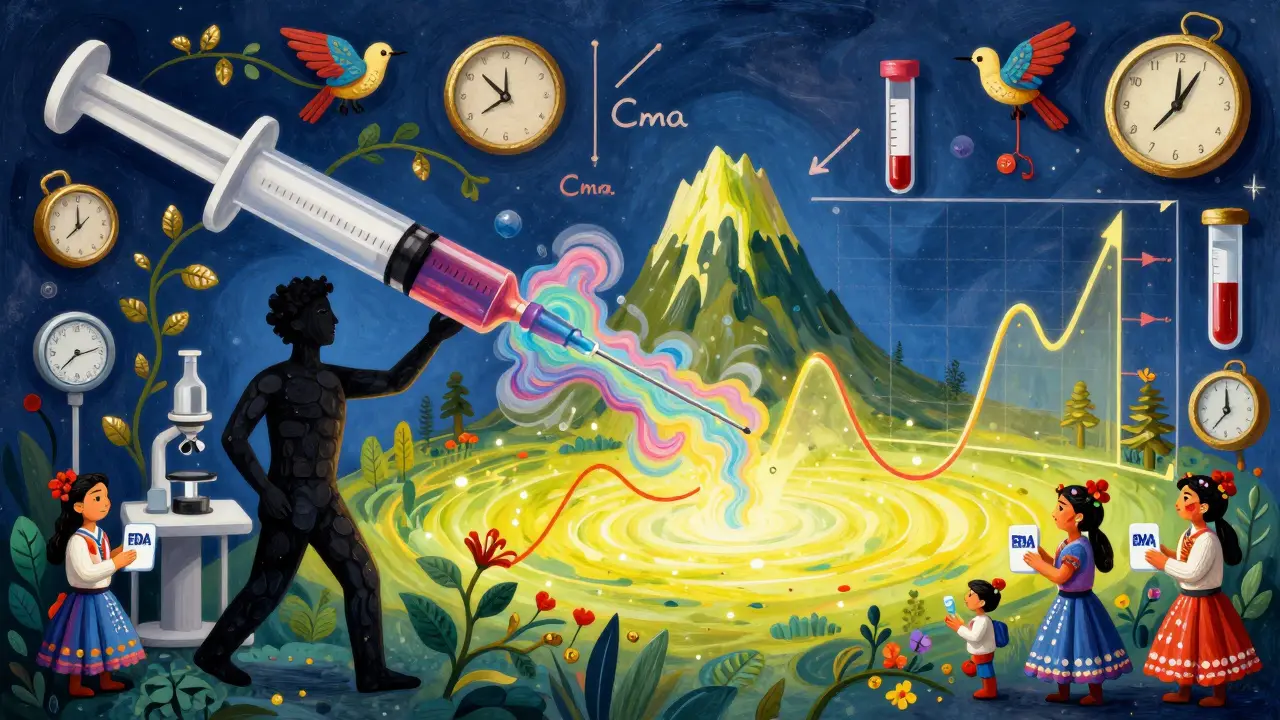
If Cmax is the peak, AUC is the whole mountain. AUC stands for area under the curve-a mathematical way to measure total drug exposure over time. Imagine plotting drug levels in your blood from the moment you take the pill until it’s mostly gone. The space under that curve? That’s AUC. It’s measured in mg·h/L.
This number matters because many drugs work based on how much total drug your body sees over hours or days. Antibiotics, antivirals, and antidepressants often rely on sustained exposure. A drug with a low Cmax but high AUC might still be effective. But if AUC is too low, the drug won’t last long enough to work. Too high, and you risk side effects from drug buildup.
For instance, in a 2007 study comparing a brand-name drug and its generic, the innovator had an AUC of 124.9 mg·h/L, while the generic was 112.4 mg·h/L. That’s a 9% difference. Under today’s rules, that’s still acceptable. But if the gap were 30%, regulators would reject it. Why? Because AUC reflects total exposure-and that’s directly linked to how well the drug works and how safe it is.
The 80%-125% Rule: How Bioequivalence Is Proven
Here’s the rule everyone follows: for a generic to be approved, the 90% confidence interval for the ratio of its AUC and Cmax to the brand-name drug must fall between 80% and 125%. That means the generic’s AUC can’t be less than 80% or more than 125% of the original. Same for Cmax.
This range isn’t random. It comes from decades of data and statistical modeling. In logarithmic terms, it’s symmetrical: ln(0.8) = -0.2231 and ln(1.25) = 0.2231. This accounts for the fact that drug concentrations in blood don’t follow a normal bell curve-they follow a log-normal distribution. That’s why statisticians transform the data before analysis.
Both AUC and Cmax must pass this test. One isn’t enough. You can’t say, “The AUC is fine, so we’ll ignore Cmax.” That’s not how regulators think. A drug might have the same total exposure (AUC) but a wildly different peak (Cmax). That’s dangerous. A rapid spike in Cmax could cause dizziness or nausea, even if the total dose is correct. That’s why the FDA and EMA both require both parameters.

Why This Matters: Real-World Consequences
There was a time when some generic drugs were pulled because they didn’t meet these standards. In 2018, a generic version of a blood pressure medication was withdrawn after reports of patients experiencing unusually low blood pressure. The generic had a higher Cmax than the brand, leading to sudden drops in pressure. The AUC was fine-but the peak was too high.
For drugs with a narrow therapeutic index-where the difference between a helpful dose and a toxic one is tiny-this is even more critical. Drugs like levothyroxine (for thyroid), warfarin (a blood thinner), and phenytoin (for seizures) have been flagged by the EMA for tighter limits: 90%-111%. Why? Because even a 10% change in exposure can lead to under-treatment or dangerous side effects.
And yet, studies show most generics do fine. A 2021 analysis of 500 bioequivalence studies found that 82% of generics had AUC ratios between 90% and 110% of the brand. Cmax was slightly more variable, with 78% falling in that range. That’s reassuring. But it also shows why the rules exist: to catch the outliers.
Challenges and Exceptions
Not all drugs are created equal. Some have high variability between people. One person might absorb a drug quickly, another slowly-even with the same pill. When intra-subject variability exceeds 30%, the standard 80%-125% rule can be too strict. It might block a perfectly safe and effective generic.
That’s why the EMA allows scaled bioequivalence for highly variable drugs. Instead of fixed limits, the acceptable range expands based on how variable the drug is. The FDA does something similar, but with different rules. This is still debated. Some experts worry it opens the door to weaker generics. Others say it’s the only fair way to handle tricky drugs.
Another challenge? Sampling. If a study doesn’t collect enough blood samples early on, it might miss the true Cmax. Industry data shows that 15% of failed bioequivalence studies are due to poor sampling schedules. That’s why protocols now specify exact times-like 0.25, 0.5, 1, 1.5, 2, 3, 4, 6, 8, 12, 24 hours-and use actual times, not just scheduled ones.
The Bigger Picture: Why Cmax and AUC Still Rule
With all the new tech-AI, modeling, simulation-you’d think we’d move beyond these old metrics. But we haven’t. And we won’t anytime soon. Why? Because they’ve been tested, validated, and proven over 40 years. Over 1,200 generic drugs were approved in 2022 alone, all relying on AUC and Cmax. The global bioequivalence market is worth over $2 billion and growing.
The FDA’s 2023 draft guidance on complex formulations still says: “AUC and Cmax remain the primary endpoints.” Even for extended-release pills or patches, where absorption is messy, regulators still start with these two numbers. They might add partial AUC or other measures later, but the foundation stays.
And it’s not just the U.S. Nearly 120 countries use the same standards. The WHO, ICH, EMA, and Health Canada all align on this. That’s rare in global regulation. It shows how solid the science is.
What This Means for You
If you take a generic drug, you’re not taking a lesser version. You’re taking one that’s been proven to deliver the same peak and total exposure as the brand. That’s not marketing. That’s science. The numbers don’t lie. Cmax and AUC are the quiet guardians of drug safety.
Next time you pick up a generic, remember: behind that simple label is a complex, rigorous process. Two numbers. Hundreds of blood samples. Thousands of data points. And one goal: to make sure your medicine works, every time.
What’s the difference between Cmax and AUC in bioequivalence?
Cmax measures the highest concentration of a drug in the bloodstream-the peak level-while AUC measures the total drug exposure over time. Cmax tells you how fast the drug is absorbed, and AUC tells you how much of the drug your body has been exposed to overall. Both are required to prove that a generic drug behaves the same way as the brand-name version.
Why do regulators require both Cmax and AUC to pass bioequivalence tests?
Because they measure different things. A drug could have the same total exposure (AUC) as the brand but a much higher peak (Cmax), leading to side effects. Or it could have a normal peak but low overall exposure, meaning it doesn’t work long enough. Requiring both ensures the generic matches the brand in both speed and total amount of drug delivered. Regulatory agencies like the FDA and EMA say neither metric alone is enough.
What does the 80%-125% range mean in bioequivalence?
It’s the acceptable range for the ratio of a generic drug’s AUC or Cmax compared to the brand-name drug. If the 90% confidence interval of that ratio falls between 0.8 and 1.25, the drugs are considered bioequivalent. This range is based on decades of clinical data showing that differences smaller than 20% are not clinically meaningful for most drugs. It’s not a target-it’s a statistical safety margin.
Are there drugs that need tighter bioequivalence limits?
Yes. Drugs with a narrow therapeutic index-like warfarin, levothyroxine, and phenytoin-have very small differences between effective and toxic doses. For these, regulators like the EMA recommend tighter limits: 90% to 111%. Even small changes in exposure can cause serious side effects or treatment failure. These stricter rules are based on clinical evidence, not just statistical theory.
Can a generic drug fail bioequivalence even if it looks identical to the brand?
Absolutely. Two pills can look identical but have different inactive ingredients, coating, or manufacturing processes that affect how the drug dissolves and absorbs. A generic might release the drug too slowly or too quickly, leading to a Cmax or AUC outside the 80%-125% range. That’s why bioequivalence studies test the drug’s behavior in the body-not its appearance.


