
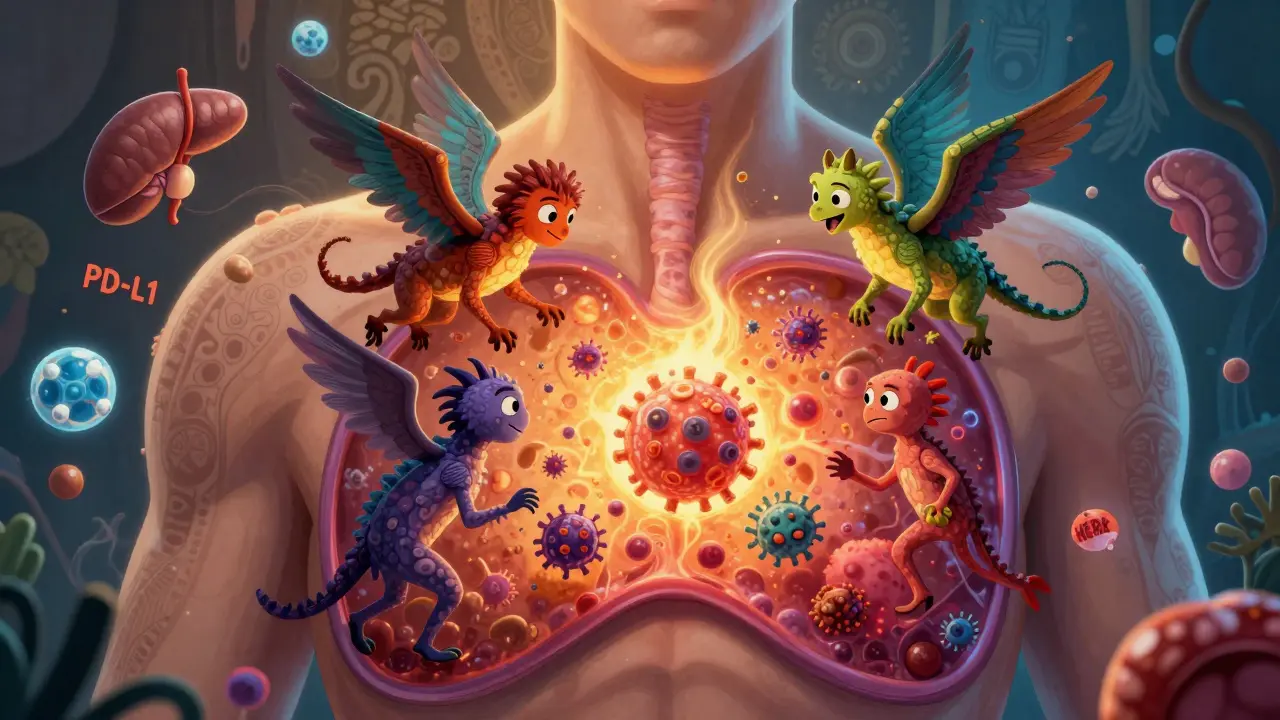
When you’re facing cancer surgery, one of the most important decisions isn’t about the scalpel-it’s about when to give treatment. Should you start chemotherapy or immunotherapy before the operation, or wait until after? This isn’t just a medical detail-it can change your chances of survival, your recovery time, and even your quality of life. For many cancers, especially lung and breast cancer, the choice between neoadjuvant and adjuvant therapy is now a central part of treatment planning.
What’s the Difference Between Neoadjuvant and Adjuvant Therapy?
Neoadjuvant therapy means treatment given before surgery. Think of it as preparing the battlefield. Doctors use it to shrink tumors, make them easier to remove, and kill hidden cancer cells that may have already spread. Adjuvant therapy, on the other hand, is given after surgery. It’s like cleaning up the last remaining threats-targeting any cancer cells left behind that imaging can’t see.
The goal of both is the same: stop cancer from coming back. But how they do it, and when they do it, creates very different experiences for patients.
Why Neoadjuvant Therapy Is Changing the Game
For years, adjuvant therapy was the standard. But since the early 2020s, things have shifted-especially in non-small cell lung cancer (NSCLC) and triple-negative breast cancer (TNBC). The big breakthrough came with the CheckMate 816 trial in 2022. Patients with stage IB to IIIA NSCLC who got neoadjuvant nivolumab (an immunotherapy drug) plus chemotherapy had a 24% rate of pathologic complete response (pCR)-meaning no live cancer cells were found in the tumor after treatment. That’s compared to just 2.2% with chemo alone.
What does pCR mean for you? It’s not just a lab result. Patients who achieve pCR are far more likely to stay cancer-free long-term. In TNBC, a pCR can double the chances of surviving five years. That’s why doctors now see neoadjuvant therapy as more than just a way to shrink tumors-it’s a way to test how your cancer responds to treatment in real time.
Imagine knowing, weeks before surgery, whether the drugs are working. If they are, you can feel confident. If they aren’t, your team can adjust your plan before cutting into your body. That kind of feedback isn’t possible with adjuvant therapy-you only find out after the fact.
When Adjuvant Therapy Still Makes Sense
But neoadjuvant isn’t right for everyone. Some patients don’t want to wait. They’d rather get surgery done quickly and start treatment afterward. Others have tumors that are already small and easy to remove-there’s no need to delay surgery for chemo or immunotherapy.
Adjuvant therapy is still the go-to for many early-stage cancers. In breast cancer, for example, if your tumor is hormone-receptor-positive and small, your doctor might skip neoadjuvant therapy entirely. You’ll have surgery first, then take hormonal pills for five to ten years. It’s less intense, and for some, less risky.
Also, not all patients tolerate neoadjuvant treatment well. About 10-15% of people experience side effects serious enough to delay surgery. That means longer hospital stays, more scans, and more stress. If your cancer is slow-growing and you’re otherwise healthy, adjuvant therapy might be the safer, simpler path.

The New Debate: Do You Need Both?
Here’s where it gets complicated. For a few years, the trend was to give immunotherapy both before and after surgery-neoadjuvant plus adjuvant. The idea was: hit it hard early, then keep hitting it. But a major 2024 meta-analysis in JAMA Network Open looked at over 3,200 patients across four major trials and found something surprising: adding adjuvant immunotherapy didn’t improve survival. It just added more side effects.
Patients who got neoadjuvant immunotherapy alone had the same survival rates as those who got it before and after. But the group that got both had nearly 30% experiencing severe side effects like lung inflammation, liver damage, or autoimmune reactions. The group that got only neoadjuvant? Around 18%.
That’s changed the conversation. Leading oncologists like Dr. Mark Awad from Dana-Farber now argue that continuing immunotherapy after surgery may be unnecessary for most patients. The American Society of Clinical Oncology (ASCO) updated its 2023 guidelines to reflect this: neoadjuvant-only is now considered a valid, even preferred, option for many.
Who Gets Which Treatment? It Depends on the Cancer
There’s no one-size-fits-all. The decision is based on cancer type, stage, and biology.
- Non-small cell lung cancer (NSCLC): If your tumor is stage IB (over 4 cm) to IIIA, and you’re healthy enough for chemo and immunotherapy, neoadjuvant nivolumab plus chemo is now standard. PD-L1 expression ≥1% improves your odds.
- Triple-negative breast cancer (TNBC): Neoadjuvant chemo is common. About 30-40% of patients reach pCR. If you do, your long-term outlook is excellent. If you don’t, your doctor might add capecitabine after surgery.
- HER2-positive breast cancer: Neoadjuvant therapy with trastuzumab and pertuzumab plus chemo is standard. pCR rates are even higher-up to 60% in some cases.
- Hormone-receptor-positive breast cancer: Usually treated with surgery first, then hormone therapy. Neoadjuvant is only used if the tumor is large or causing symptoms.
For all types, doctors now use imaging (CT, PET scans) and biomarkers (PD-L1, BRCA, HER2) to decide. A 2023 survey found that 78% of oncologists now offer neoadjuvant immunotherapy for NSCLC-up from 42% just two years earlier.
What Happens Between Treatment and Surgery?
Timing matters. Neoadjuvant therapy usually lasts 3 to 4 cycles, about 9 to 12 weeks. After the last dose, surgery is scheduled 3 to 6 weeks later. That window lets your body recover from side effects like fatigue, low blood counts, or nausea. Rushing surgery too soon increases risks. Waiting too long risks tumor regrowth.
During this time, you’ll have follow-up scans. If the tumor shrinks dramatically, that’s good news. If it grows or stays the same, your team may rethink the plan. Some centers now use circulating tumor DNA (ctDNA) tests to detect cancer cells in the blood. If ctDNA is still present after neoadjuvant therapy, it’s a red flag-your cancer might be more aggressive, and you’ll need stronger treatment after surgery.
Real Stories, Real Choices
One patient in Manchester, diagnosed with stage IIA NSCLC in early 2024, chose neoadjuvant nivolumab and chemo. After three cycles, his tumor had shrunk by 85%. His surgeon called it the easiest operation he’d done in months. He had no cancer left in the removed tissue. He skipped adjuvant immunotherapy and is now in remission, with far fewer side effects than his friends who got both.
Another woman, diagnosed with stage II TNBC, chose adjuvant chemo after surgery. She didn’t want to delay the operation. But later, her pathology report showed no pCR-only 10% of the tumor was killed. She wished she’d known upfront how her cancer would respond. She’s now on a clinical trial testing ctDNA-guided therapy to catch recurrence early.
These aren’t outliers. A 2023 survey by the Lung Cancer Alliance found that 62% of patients on neoadjuvant therapy felt anxious during the waiting period. But 71% said knowing how their cancer responded gave them more control.
Barriers to Access
Not every hospital can offer neoadjuvant therapy the way it should. The National Comprehensive Cancer Network (NCCN) says treatment should be planned by a multidisciplinary team-surgeons, oncologists, radiologists, pathologists-all working together. But only 58% of community hospitals have that setup. Academic centers? 92% do.
Pathology labs need special training to assess pCR accurately. Radiologists need to use RECIST criteria to measure tumor shrinkage correctly. If those steps aren’t done right, you might miss the real benefit of neoadjuvant therapy.
Cost and insurance can also be hurdles. While FDA and EMA approved neoadjuvant nivolumab in 2022, not all insurers cover it without prior authorization. Some patients wait weeks for approval-time that could affect outcomes.
The Future: Personalized Sequencing
The next big step isn’t just choosing between before and after. It’s choosing who needs what, based on biology.
Trials like NeoADAURA are testing whether EGFR-mutant NSCLC patients benefit from targeted drugs like osimertinib before surgery. Early data suggests they do. Other trials are using ctDNA to decide who needs extra treatment after surgery. If ctDNA disappears after neoadjuvant therapy, you might skip adjuvant drugs entirely. If it’s still there? You get a stronger, targeted boost.
By 2030, experts predict that 70% of early-stage NSCLC patients will get biomarker-driven neoadjuvant therapy. Survival rates could jump from 60-68% to 75-80%. That’s 15,000 to 20,000 more lives saved every year in the U.S. alone.
This isn’t science fiction. It’s happening now. The future of cancer treatment isn’t just about stronger drugs-it’s about smarter sequencing. Giving the right treatment, at the right time, to the right person.
Is neoadjuvant therapy better than adjuvant therapy for survival?
For many cancers like NSCLC and triple-negative breast cancer, neoadjuvant therapy offers similar survival rates to adjuvant therapy-but with the added benefit of letting doctors see how the tumor responds before surgery. In some cases, like with immunotherapy combinations, neoadjuvant-only treatment gives the same survival as neoadjuvant-plus-adjuvant, but with fewer side effects.
Can I skip surgery if neoadjuvant therapy works?
No. Even if imaging shows the tumor is gone, surgery is still required for most cancers. Pathologic complete response (pCR) is confirmed by examining the removed tissue under a microscope. Some patients with very early-stage cancer in clinical trials are being studied for non-surgical options, but this is not yet standard care.
Why do some doctors still recommend adjuvant therapy after neoadjuvant?
Some doctors believe that even after neoadjuvant therapy, hidden cancer cells might still be present. For patients who don’t achieve pCR-or have high-risk features like lymph node involvement-adjuvant therapy can reduce relapse risk. But new data shows that for patients who do achieve pCR, extra treatment may not help and only adds risk.
How long does neoadjuvant therapy last before surgery?
Typically, 3 to 4 cycles over 9 to 12 weeks. After the last dose, surgery is scheduled 3 to 6 weeks later to allow recovery from side effects like low blood counts or fatigue. This timing is based on clinical trial data showing the best outcomes with this window.
What if my tumor doesn’t shrink during neoadjuvant therapy?
If the tumor doesn’t respond, your oncology team will reassess. You may still have surgery if the cancer is operable, but your post-surgery treatment plan will likely change. You might get different chemo, targeted therapy, or enrollment in a clinical trial. A lack of response is a signal-not a dead end.
Are there risks to delaying surgery for neoadjuvant therapy?
Yes. In about 5-10% of NSCLC cases, the cancer can progress during neoadjuvant treatment, making surgery harder or impossible. That’s why close monitoring with scans and blood tests is critical. But for most patients, the benefits of shrinking the tumor and killing hidden cells outweigh this risk.


