Exercise and Statins: What You Need to Know About Muscle Pain and Recovery

Exercise and Statins: What You Need to Know About Muscle Pain and Recovery

Statin Exercise Safety Calculator

Safe Exercise Intensity Assessment

Find out if your exercise routine is safe while taking statins based on your medication type and activity level.

Guidance: Your exercise routine is generally safe.
Warning: Your exercise routine may increase muscle damage risk.

Recommended Actions

When you’re on statins and start feeling muscle soreness, it’s natural to wonder: is exercise making it worse? You’ve been told to move more for your heart, but now every step feels like a gamble. You’re not alone. Millions of people taking statins face this exact dilemma - and the truth isn’t as simple as ‘stop exercising’ or ‘push through the pain.’

Statins and Muscle Pain: It’s Not All in Your Head

Statins work by blocking an enzyme your liver uses to make cholesterol. But that same enzyme is also involved in producing coenzyme Q10 (CoQ10), a compound your muscles need for energy. When statins cut CoQ10 by up to 40% within weeks, your muscles don’t get the fuel they need - especially during physical activity. This isn’t just a theory. Studies show that even people who don’t feel pain still have higher levels of muscle damage markers like creatine kinase (CK) after exercise compared to those not on statins.

Not everyone gets muscle pain. About 5-10% of people report noticeable symptoms in clinical trials, but real-world numbers are higher - up to 29% according to a 2014 JAMA study. Why the difference? Some people are genetically more sensitive. A variant in the SLCO1B1 gene makes it harder for the body to clear certain statins from muscle tissue, increasing the risk of damage by more than double.

Not All Statins Are Created Equal

If you’re struggling with muscle pain, your specific statin might be the issue. Lipophilic statins - like atorvastatin, simvastatin, and lovastatin - slip easily into muscle cells. Hydrophilic statins - such as pravastatin and rosuvastatin - don’t penetrate muscle tissue as deeply. This matters. A 2022 FDA analysis found that high-dose atorvastatin (80 mg) carried a 10.5-fold higher risk of severe muscle injury than pravastatin (40 mg). One study showed that after six months, people on 80 mg of atorvastatin had 11.3% higher CK levels than those on placebo, even if they felt fine.

Switching from a lipophilic to a hydrophilic statin helped 65% of patients in a 2023 meta-analysis reduce or eliminate muscle pain. Some people even find relief by switching to every-other-day dosing - a strategy that works for about 58% of users. It’s not a cure-all, but it’s often the first step doctors should consider before dropping statins entirely.

Exercise Isn’t the Enemy - Intensity Is

The big question: Should you stop working out? The answer is no - but you need to be smart about it. Moderate exercise, like brisk walking, cycling at a steady pace, or swimming, is safe. A 2023 study from Radboud University Medical Center followed 105 people - some on statins, some not - and had them cycle for 30 minutes at moderate intensity. The results? No significant difference in muscle damage markers between groups. Even people who reported muscle pain before the test didn’t get worse.

But vigorous exercise? That’s where trouble starts. High-intensity interval training (HIIT), heavy weightlifting, and long-distance endurance events like marathons can push muscle damage into dangerous territory. A 2007 study of Boston Marathon runners found statin users had nearly 50% higher CK levels after the race than non-users. One cyclist, Maria Rodriguez, ended up in the hospital with rhabdomyolysis after combining high-dose simvastatin with intense training - her CK hit 12,450 U/L (normal is 30-200).

Eccentric exercise - movements where muscles lengthen under tension, like downhill running or lowering weights slowly - is especially risky. A 2016 study showed statin users had a 300% spike in CK after eccentric training, compared to 200% in controls. That’s not a small difference. It’s a red flag.
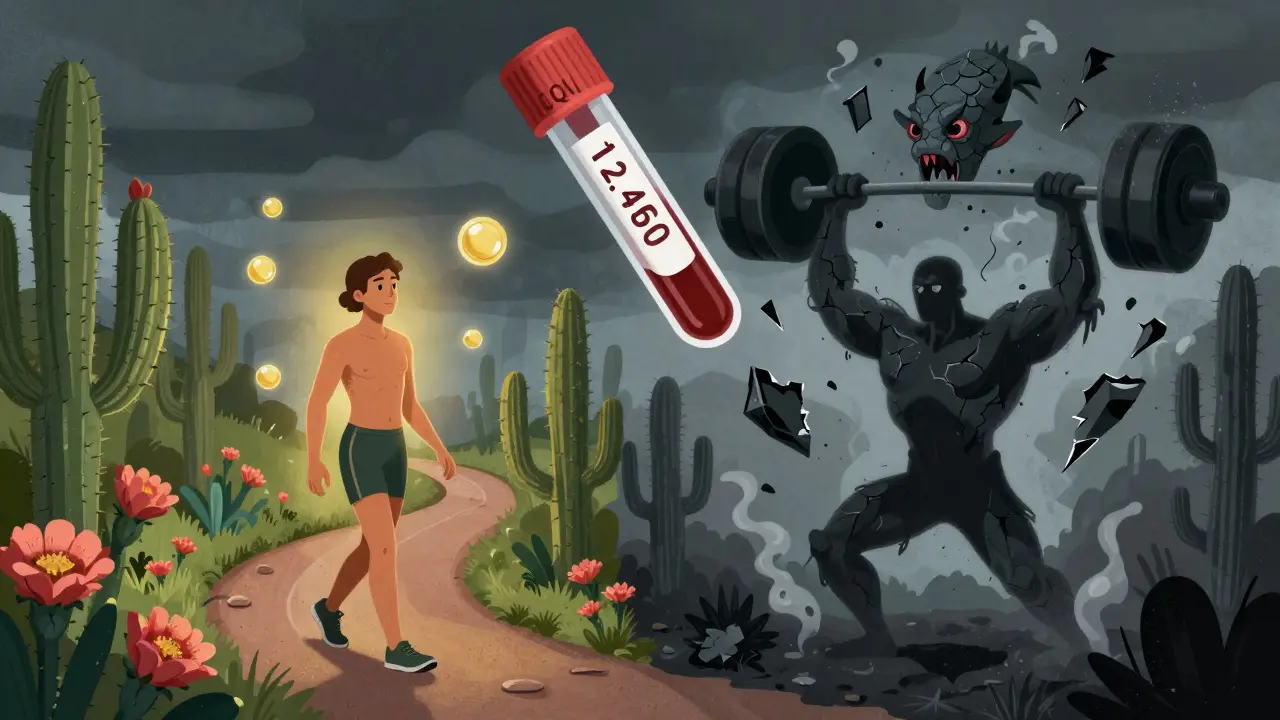
A person walks calmly on one side while another suffers muscle damage from intense exercise, with a blood test showing high CK levels.

What About Long-Term Exercise? Walking 50 km for 4 Days?

Here’s something surprising: prolonged moderate activity might be safer than short bursts of intensity. The 4Days Marches in the Netherlands tracked 100 people walking 30-50 km a day for four straight days. Half were on statins. At the end? No difference in muscle pain or CK levels between the two groups. Their CK rose from 150 to 350 U/L - a normal response to extended walking. The key? Consistency. Moderate, steady movement doesn’t overload muscles the way sudden spikes do.

People who exercised regularly before starting statins were 37% less likely to develop muscle pain, according to Harvard Health. Your body adapts. If you’ve been active for years, your muscles are better equipped to handle the stress - even with statins. That’s why quitting exercise often makes things worse. Inactivity leads to muscle loss, which makes future activity harder and more painful.

How to Tell If It’s Statin Pain or Exercise Pain

Confusing the two is common - and dangerous. Here’s how to tell them apart:

  • Statin pain: Comes on gradually, usually within 30 days of starting or increasing the dose. It’s constant - whether you exercise or not. Often felt in thighs, shoulders, or calves. Doesn’t go away with rest.
  • Exercise pain: Happens right after a workout. Feels like soreness or stiffness. Gets better over 1-3 days. Returns only after similar activity.

If your pain started after you began statins and doesn’t improve with rest, it’s likely statin-related. If it only happens after you lift weights or run hard, it’s probably exercise-induced. But if you’re unsure - get a blood test. CK levels above 1,000 U/L (5x normal) mean you’re at risk for serious muscle damage. The Mayo Clinic recommends checking CK before starting a new exercise routine and again 24-48 hours after intense activity.
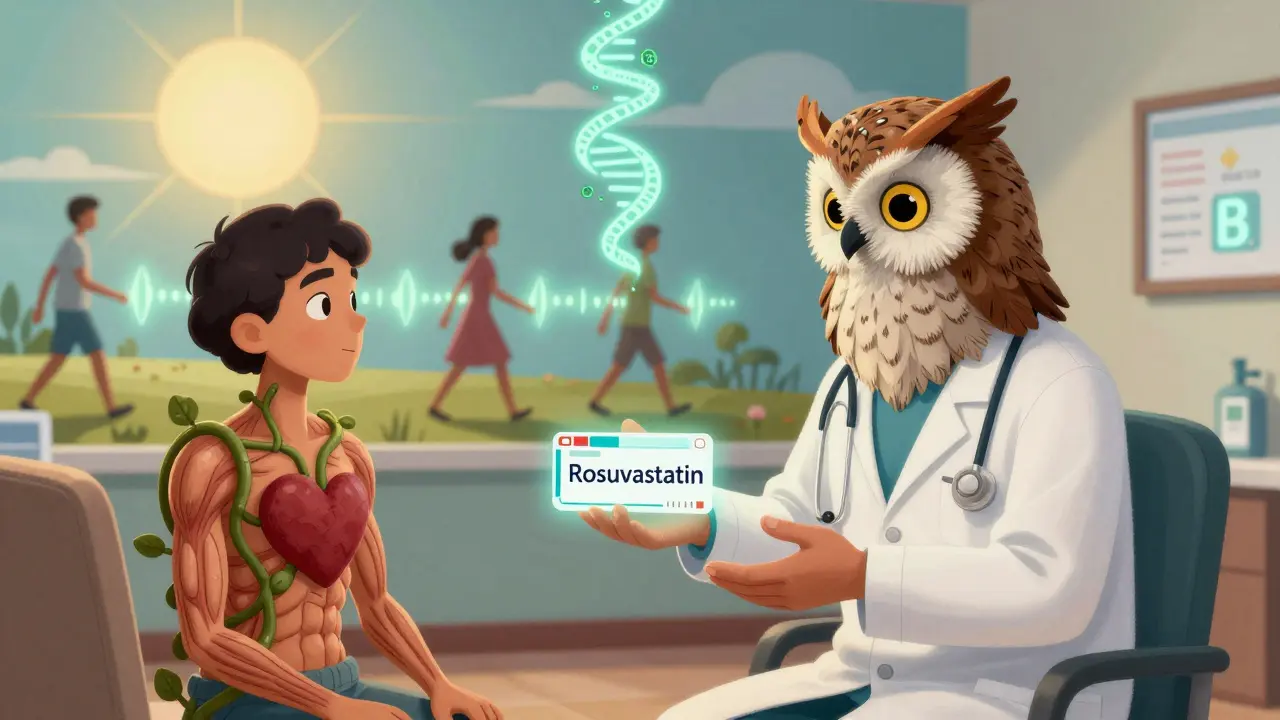
A doctor owl alebrije gives a patient a rosuvastatin prescription, with a mural of walkers and a genetic snake spiral in the background.

What to Do If You’re in Pain

You don’t have to choose between your heart and your muscles. Here’s what works:

  1. Start slow. Walk 10-15 minutes a day at a pace where you can talk but not sing. Increase by 5 minutes weekly.
  2. Avoid HIIT and heavy lifting. Stick to steady-state cardio: walking, cycling, elliptical, swimming.
  3. Switch statins. Talk to your doctor about switching to rosuvastatin or pravastatin. Many patients feel better within weeks.
  4. Try CoQ10. A daily 200 mg supplement helped reduce muscle pain in 60% of users in a 2023 meta-analysis. It won’t fix everything, but it helps some people.
  5. Don’t quit. Stopping exercise increases your risk of heart disease more than continuing statins with mild muscle pain.

Success stories exist. John Davis, a marathon runner, switched from atorvastatin to rosuvastatin and kept running 40 miles a week. His pain vanished. He didn’t give up his goals - he adjusted his tools.

The Bigger Picture: Statins Still Save Lives

Statins reduce heart attacks by 25-30% and strokes by 20-25% in high-risk people. For many, the benefits far outweigh the risks. But if you’re one of the 1 in 4 who feels muscle pain, you deserve better guidance - not fear.

Doctors are catching on. In 2022, only 54% of cardiologists encouraged exercise for patients with muscle pain. By early 2024, that number jumped to 82%. The American College of Cardiology now says moderate exercise is safe - even for those with symptoms. The American College of Sports Medicine is finalizing new guidelines for statin users, due out in early 2025.

The future is personalized. Genetic testing for the SLCO1B1 variant is already available. Within five years, your doctor may use your DNA to decide which statin to prescribe - and how much exercise is safe for you.

For now, here’s the bottom line: Keep moving, but move wisely. Don’t stop. Don’t push too hard. Talk to your doctor. Adjust your meds if needed. And remember - your heart needs you to stay active. You just need to find the right way to do it.

Comments (13)

  1. Drew Pearlman
    Drew Pearlman January 10, 2026

    Hey, I’ve been on rosuvastatin for three years and walk 5 miles every morning without a hitch. The key isn’t avoiding exercise-it’s listening to your body. If you’re sore the next day, dial it back. If you’re fine, keep going. Statins aren’t a life sentence to couch mode. My doctor said the same thing: moderate movement is medicine, not a threat.

  2. Meghan Hammack
    Meghan Hammack January 11, 2026

    THIS. I was terrified to move after starting atorvastatin. Then I started walking 20 minutes a day-just enough to break a light sweat. No pain. No panic. Now I do yoga and swim. You don’t need to run marathons to protect your heart. Gentle is powerful. You got this.

  3. RAJAT KD
    RAJAT KD January 13, 2026

    CoQ10 supplements work. Took 200mg daily. Muscle pain gone in 11 days. No magic, just science.

  4. Aron Veldhuizen
    Aron Veldhuizen January 14, 2026

    Let’s be honest-this whole ‘statins cause muscle pain’ narrative is a pharmaceutical-induced panic. You’re told to exercise, then told exercise is dangerous because of a drug you were prescribed? That’s not a medical dilemma-it’s a systemic failure. If your body can’t handle movement while on statins, maybe the statin is the problem, not the movement. The real issue? Doctors still treat patients like lab rats instead of humans.

    And don’t get me started on CoQ10 being ‘supposed’ to help. It’s a band-aid on a bullet wound. The real fix is stopping the damn statin if it’s causing damage. The heart doesn’t need cholesterol suppression-it needs functional mitochondria. And statins starve them. The data is clear. We’re treating symptoms, not causes. We’ve turned prevention into a chemical cage.

    And now we’re told to ‘walk more’ while our muscles are being slowly dismantled? That’s not wisdom. That’s institutional gaslighting. If you’re taking statins and you feel pain, stop. Not ‘switch’. Not ‘reduce intensity’. Stop. Let your body recover. Then re-evaluate. Don’t let fear of heart disease make you ignore the damage you’re doing right now.

    And for the love of all that’s logical, stop calling this ‘personalized medicine’ when the only personalization is which brand of statin they shove at you. Real personalization means listening to the patient. Not the label.

  5. Jacob Paterson
    Jacob Paterson January 14, 2026

    Oh please. ‘Walk more’? That’s what you tell someone with CK levels at 1,200? You’re not a doctor, you’re a wellness influencer with a blog. Real medicine doesn’t say ‘try walking’ when someone’s muscles are literally dissolving. If you’re on a statin and you’re in pain, you need a blood test-not a motivational poster. This article reads like a pharma ad disguised as advice.

    And CoQ10? That’s not a solution. It’s a placebo for people who refuse to admit their doctor made a mistake. The real answer? Dose reduction or switch. Not ‘add a supplement and keep lifting’.

  6. Chris Kauwe
    Chris Kauwe January 14, 2026

    Let’s cut through the noise: the American healthcare system is broken. Statins are overprescribed because they’re cheap, profitable, and easy to monitor. Meanwhile, real solutions-diet, sleep, stress management-are ignored because they don’t come in a pill bottle. The fact that we’re debating whether walking 5 miles a day is ‘safe’ while people are on 80mg atorvastatin speaks volumes. We’ve outsourced health to chemistry and called it progress.

    And yet, we’re still shocked when people get muscle damage? No. We’re shocked when they start asking questions. The real enemy isn’t statins. It’s the passive acceptance of ‘doctor knows best’ without critical inquiry.

    My uncle was on simvastatin for five years. His CK was always elevated. He never complained. Then one day, he couldn’t climb stairs. He got tested. CK was 8,700. Rhabdomyolysis. ICU for three days. He’s off statins now. Walks 10k steps daily. His LDL is higher. His heart? Still beating. His muscles? Working. His life? Better.

    Don’t let corporate medicine tell you what your body can handle. Your body speaks. Listen.

  7. Pooja Kumari
    Pooja Kumari January 15, 2026

    I’ve been on pravastatin for two years now and I started doing yoga every morning. At first, I was terrified. I thought every stretch would kill me. But I just went slow. I cried the first week because I felt so weak. But now? I feel stronger than I have in 10 years. My muscles don’t ache anymore. I think it’s because I moved gently. I didn’t force it. I didn’t compare myself to others. I just showed up. And my heart? It’s happier. I don’t know if it’s the statin or the yoga or the fact that I finally stopped hating my body. But I feel alive again. Thank you for writing this. I needed to hear someone say it’s okay to move gently.

  8. Diana Stoyanova
    Diana Stoyanova January 17, 2026

    Okay, I’m gonna say it: the real hero here isn’t the statin. It’s the person who shows up every day-even when they’re scared. Even when their body feels like it’s betraying them. I was diagnosed with high cholesterol at 38. I started on atorvastatin. Within two weeks, I could barely lift my arms. I thought I was done with life. But I didn’t quit. I walked. I swam. I cried. I took CoQ10. I switched to rosuvastatin. And now? I hike mountains. I do Pilates. I laugh. I’m not ‘cured.’ But I’m alive. And that’s the point. Medicine isn’t about perfection. It’s about persistence. You don’t have to be strong. You just have to keep showing up. That’s the real victory.

    So if you’re reading this and you’re scared? I see you. And I’m proud of you. Keep moving. Even if it’s just one step. One breath. One day at a time. You’re not broken. You’re becoming.

  9. Jenci Spradlin
    Jenci Spradlin January 18, 2026

    yo i was on simva for 8 months and my legs felt like concrete. switched to pravastatin and started walking 20 min a day. no more pain. i swear. also took coq10. i know it sounds dumb but it worked. dont overthink it. just move slow and talk to your doc. no need to be a hero.

  10. Matthew Maxwell
    Matthew Maxwell January 20, 2026

    It is both scientifically and ethically irresponsible to suggest that individuals with elevated creatine kinase levels continue physical exertion under the assumption that ‘moderate exercise’ is universally safe. The literature is unequivocal: statin-induced myopathy is dose-dependent and genetically modulated. To trivialize this condition as a matter of ‘walking more’ is not only medically unsound, it is dangerously paternalistic. The American College of Cardiology’s updated guidelines, while well-intentioned, lack sufficient stratification for high-risk genotypes. Until genetic screening becomes standard-and it must-prescribing exercise as a therapeutic adjunct to statin therapy remains an act of clinical negligence.

    Furthermore, the promotion of CoQ10 supplementation as a mitigating agent lacks sufficient phase III trial validation. To present it as a viable solution is to mislead the public under the guise of ‘holistic’ care. Evidence-based medicine does not operate on anecdotes. It operates on controlled trials. And we are not there yet.

  11. tali murah
    tali murah January 22, 2026

    Oh wow. Another feel-good post about ‘walking more’ while people are getting rhabdomyolysis. Let me guess-this was written by someone who’s never had CK levels above 500? You know what’s worse than statin pain? Being told to ‘just move gently’ when your muscles are literally turning to mush. This isn’t yoga class. This is a pharmacological minefield. And you’re handing out glitter and hugs like it’s a TED Talk.

    CoQ10? Cute. But if your doctor isn’t checking your CK before and after exercise, you’re playing Russian roulette with your kidneys. And ‘switching statins’? That’s not a solution-it’s a gamble. Rosuvastatin might work for you. For me? It gave me liver enzymes through the roof. So now I’m off everything. And guess what? My heart’s fine. My muscles? Alive. My trust in doctors? Gone.

    This article reads like a marketing brochure for Big Pharma’s ‘safe statin’ spin. Real people aren’t walking 50km for four days. They’re in ERs with acute kidney failure. And you’re telling them to ‘stay active’? No. We need better drugs. Not better walking shoes.

  12. Meghan Hammack
    Meghan Hammack January 22, 2026

    I know how you feel. I was in the ER with CK at 6,300 after a spin class. I thought I was being strong. Turns out I was being stupid. I switched to pravastatin. Took CoQ10. Walked 10 minutes a day for a month. Then 20. Now I do water aerobics. No pain. No fear. You’re not weak for needing to slow down. You’re smart.

  13. Elisha Muwanga
    Elisha Muwanga January 23, 2026

    Why are we even having this conversation? Statins are a Band-Aid on a hemorrhage. We’ve turned heart disease into a chemical problem instead of a lifestyle one. We’ve got people on 80mg of atorvastatin while eating fast food daily and calling it ‘preventive care.’ That’s not medicine. That’s surrender. The real solution? Eat real food. Move your body. Sleep. Manage stress. But no-let’s just pop a pill and call it a day. Then blame the patient when their muscles give out. Pathetic.

Write a comment

Please check your email
Please check your message
Thank you. Your message has been sent.
Error, email not sent