
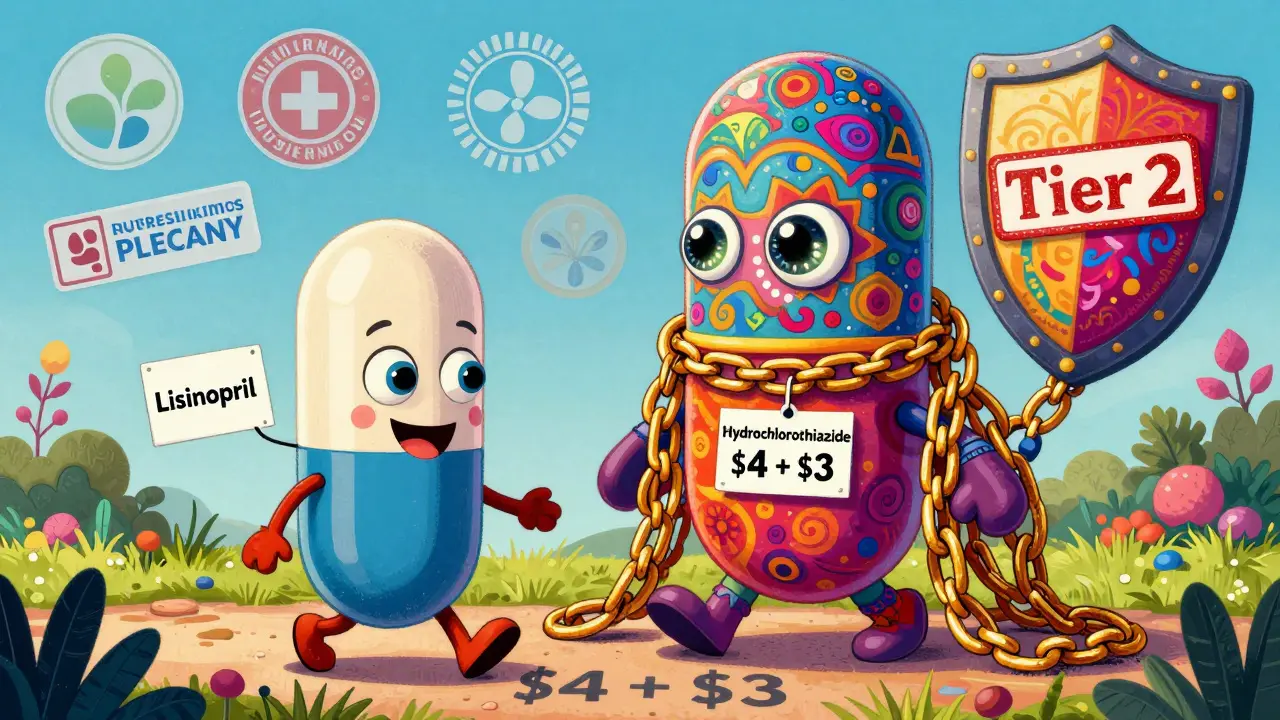
When you're on medication for high blood pressure, diabetes, or cholesterol, you might notice something strange: your insurance covers two separate pills for $5 each, but the pill that combines those same two drugs costs $40. It doesn’t make sense - until you understand how insurance formularies work. In the U.S., insurance plans don’t just decide what drugs to cover. They decide how to cover them. And when it comes to generic combinations versus individual generics, the difference can mean hundreds of dollars a year in out-of-pocket costs.
What Are Generic Combinations?
A generic combination drug is a single pill that contains two or more active ingredients, all of which are available separately as generics. For example, a common blood pressure combo pill might include lisinopril and hydrochlorothiazide - both available as individual generics. These combinations were originally developed as brand-name drugs like Exforge a brand-name combination of amlodipine and valsartan used for hypertension, but once patents expired, generic versions followed.The FDA confirms these generics are bioequivalent to brand-name versions - meaning they work the same way in your body. The only difference? Cost. Generic drugs typically cost 80-85% less than their brand-name counterparts. When multiple generics compete, prices can drop even further - up to 95% in some cases. So why doesn’t your insurance always prefer the single pill?
How Insurance Plans Structure Coverage
Most U.S. health plans - including Medicare Part D and private insurers - use a tiered system to manage drug costs. There are usually four or five tiers:- Tier 1: Preferred generics - lowest copay, often $0-$5
- Tier 2: Non-preferred generics or preferred brand-name drugs - $10-$20
- Tier 3: Non-preferred brand-name drugs - $30-$60
- Tier 4: Specialty drugs - $100+
Here’s the twist: a generic combination drug might be placed in Tier 2 or even Tier 3, while the two individual generics are both in Tier 1. That means you pay more for the convenience of one pill than for two separate ones.
In 2019, 84% of Medicare Part D plans covered only generic drugs - up from 69% in 2012. That trend is still growing. But coverage doesn’t mean equal treatment. A combination drug might be covered, but not at the same cost level as its individual components.
Why Insurance Might Prefer Individual Generics
It sounds backwards: why would a plan encourage you to take two pills instead of one? The answer is cost control.Pharmacy Benefit Managers (PBMs) - like CVS Caremark, Express Scripts, and OptumRx - control 80% of the market. These companies negotiate drug prices with manufacturers and design formularies to maximize savings. When a combination drug is new to the market, it might still be priced higher than the sum of its parts. That’s because:
- Manufacturers can’t drop prices as quickly on combination drugs - there’s less competition
- Some combination drugs are classified as “single-source generics,” meaning only one company makes them
- Formulary committees may not have reviewed the combination yet
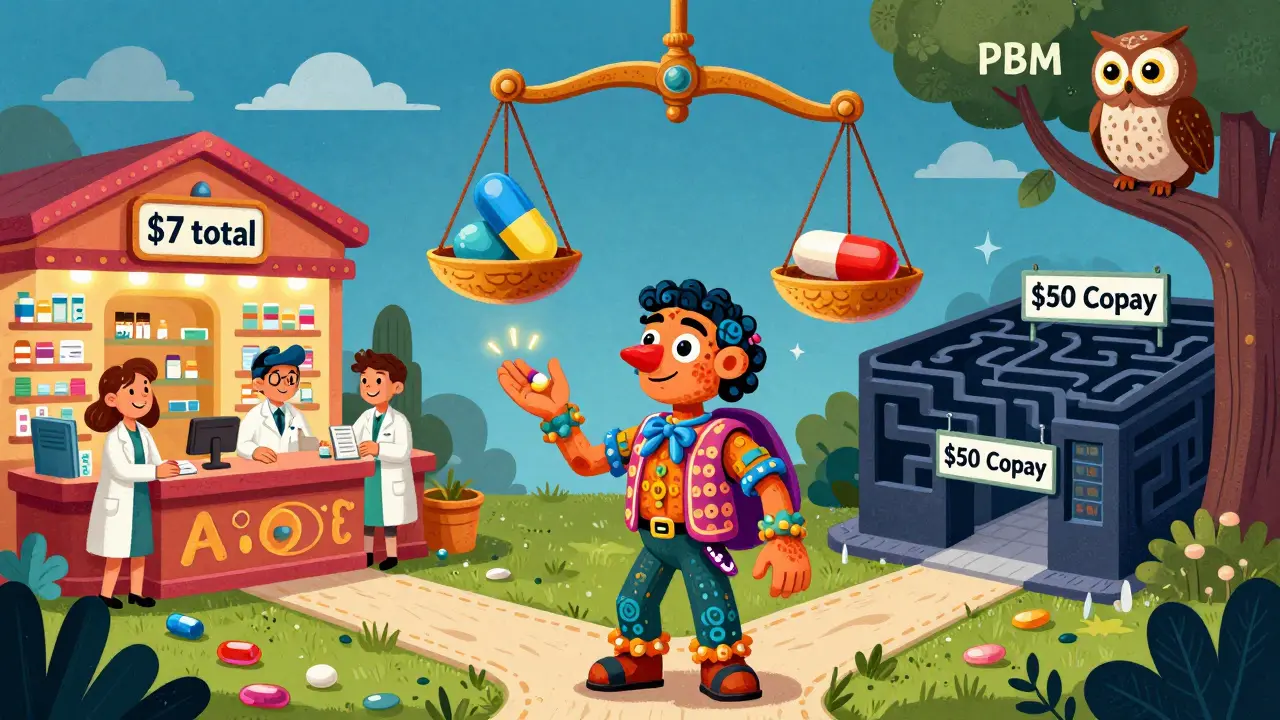
Meanwhile, individual generics have been on the market for years. With dozens of manufacturers producing them, prices have crashed. A 30-day supply of lisinopril might cost $4. A 30-day supply of hydrochlorothiazide? $3. Together? $7. The combo pill? $25.
Real Patient Experiences
On Reddit, users share stories that reflect this confusion:- "My plan covers the individual generics for $10 each but the combination product would be $50 even though it's the same ingredients - had to ask my doctor to write two separate prescriptions to save money." - u/PharmaPatient87, June 2023
- "When my blood pressure combo drug went generic, my out-of-pocket dropped from $45 to $7 per month with no change in effectiveness." - u/SeniorHealth45, September 2023
The difference between $7 and $50 isn’t a mistake - it’s a system. Some patients save money by splitting their pills. Others lose money because their plan doesn’t recognize the combo as a better value.
How Formulary Decisions Are Made
Insurance plans don’t make these choices randomly. Formulary committees - made up of doctors, pharmacists, and data analysts - review clinical evidence, cost data, and adherence studies. They look at:- Is the combo pill easier to take? (Yes - fewer pills = better adherence)
- Does it lower hospitalization rates? (Studies say yes for hypertension and diabetes combos)
- Is it priced lower than buying the two generics separately? (Often no)
Despite evidence that combination pills improve adherence, many plans still prioritize cost over convenience. That’s changing slowly. Starting January 1, 2024, the Inflation Reduction Act capped Medicare Part D out-of-pocket spending at $2,000 a year. That’s removing some of the financial pressure on plans to push the cheapest option - and may lead to more favorable coverage for combos.
What You Can Do
If you’re paying more for a combination drug than its individual components:- Check your plan’s formulary online. Use tools like the Medicare Plan Finder a government tool that compares Part D drug coverage and costs or your insurer’s drug list.
- Compare the cost of buying two generics vs. one combo pill. Sometimes the math surprises you.
- Ask your doctor to write separate prescriptions. Many doctors don’t realize this can save you money.
- Request a coverage determination. If your plan denies the combo but covers the parts, you can appeal. Standard requests take 72 hours; expedited ones take 24.
- Use GoodRx or SingleCare. These apps often show cash prices lower than your copay.
Also, watch out for copay accumulator programs. Until September 2023, some insurers didn’t count manufacturer coupons toward your deductible or out-of-pocket maximum. A federal court ruling banned this practice - a win for patients who rely on discounts.
The Bigger Picture
The U.S. generic drug market is worth over $135 billion and growing. About 90% of prescriptions are filled with generics - but only 25% of total drug spending. That’s because generics are cheap. Combination drugs make up 15% of all prescriptions but 28% of top-selling drugs. As more combo drugs go generic - and as more manufacturers enter the market - prices will drop.The FDA’s Generic Drug User Fee Amendments (GDUFA) III, running through 2027, is speeding up approval of complex generics. That means more combo drugs will become available at lower prices. Insurers will have to adapt - or risk losing members who switch plans for better coverage.
Bottom Line
Generic combinations aren’t inherently better or worse than individual generics. But insurance coverage often makes them more expensive. If you’re paying more for one pill than two, it’s not because the combo is inferior - it’s because your plan’s rules haven’t caught up with the market. Always check your options. Talk to your pharmacist. Ask your doctor to write separate prescriptions if it saves money. And don’t assume the simplest solution is the cheapest one - in pharmacy coverage, the opposite is often true.Why is my combination drug more expensive than buying two separate generics?
Insurance plans sometimes place combination drugs on higher tiers than their individual components, even if they contain the same ingredients. This happens because the combo drug may still be priced higher due to limited competition, recent market entry, or lack of formulary review. Meanwhile, individual generics have been on the market for years with many manufacturers competing, driving prices down. You may pay less by splitting your prescription into two separate generic pills.
Does Medicare cover generic combination drugs?
Yes, Medicare Part D covers generic combination drugs, but coverage varies by plan. In 2019, 84% of Part D plans covered only generic drugs. However, the combo drug might be on a higher tier than its individual components, meaning a higher copay. Always check your plan’s formulary using the Medicare Plan Finder tool to compare costs.
Can I ask my doctor to prescribe two separate generics instead of a combo pill?
Absolutely. Many patients save money by having their doctor prescribe two separate generic pills instead of one combination pill. This is especially common with blood pressure, diabetes, and cholesterol medications. As long as the doses match what your provider intended, this is a safe and legal alternative. Your pharmacist can help confirm dosing accuracy.
What is a single-source generic?
A single-source generic is a generic drug made by only one manufacturer. Unlike most generics, which have dozens of producers competing on price, single-source generics lack competition. This means their price doesn’t drop as much - sometimes staying close to brand-name levels. These are common in combination drugs, especially newer ones, and can lead to higher out-of-pocket costs.
How do I appeal if my insurance won’t cover my combination drug?
You can request a coverage determination from your plan. Your doctor must submit a letter explaining why the combination drug is medically necessary - especially if you’ve tried the individual generics and had side effects or poor adherence. Standard requests take 72 hours; expedited ones take 24 hours. If denied, you can appeal further. Medicare beneficiaries can also contact the Medicare Rights Center for free assistance.


