
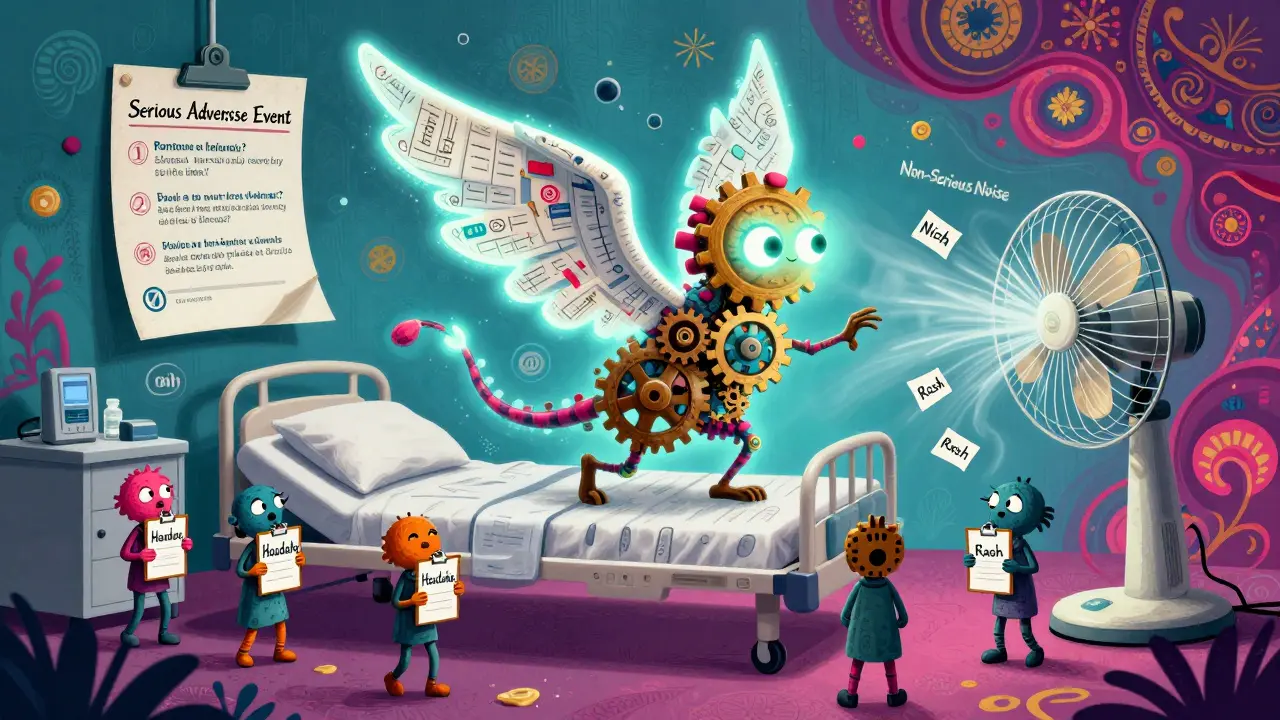
When you're running a clinical trial, every patient reaction matters-but not every reaction needs the same response. The difference between a serious adverse event and a non-serious one isn't about how bad the patient feels. It's about what happened to them. And getting this wrong can waste time, delay trials, or worse, hide a real danger.
What Makes an Adverse Event "Serious"?
An adverse event (AE) is any unwanted medical occurrence during a trial, whether it’s linked to the drug or not. But only some of these are serious. The FDA and ICH define seriousness by outcomes, not symptoms. A headache might be severe, but if it goes away in a day? Not serious. A rash that causes no hospitalization or disability? Also not serious.
Here’s the real list of what makes an event serious:
- Death
- Life-threatening condition (the patient was at immediate risk of dying)
- Requires hospitalization or extends an existing hospital stay
- Leads to permanent disability or significant loss of function
- Causes a birth defect
- Requires medical intervention to prevent one of the above
That’s it. No more, no less. A patient with a 9/10 pain score from a migraine who gets a shot at the ER and goes home? That’s not serious. A patient with a 3/10 pain score who has a heart attack and ends up in the ICU? That’s serious. Intensity doesn’t matter. Outcome does.
Why the Confusion Exists
Most people mix up "severe" and "serious." They think if something feels intense, it must be serious. But that’s not how regulators see it. Dr. Robert Temple, former FDA deputy director, called this confusion "one of the most persistent errors" in safety reporting. And it’s costly.
In 2019, nearly 37% of serious adverse event reports submitted to IRBs didn’t actually meet the seriousness criteria. That’s almost four in ten reports that took time away from real threats. At UCSF, over 40% of AE reports in 2022 needed clarification because someone misclassified them. At SWOG Cancer Research, over 30% of SAE reports had to be corrected after submission-wasting nearly 19 hours a week across their entire network.
Even more telling: the FDA’s Sentinel system has processed over 14 million adverse event reports since 2008. Only 18% of those met the seriousness threshold. That means more than 80% were noise. And that noise is drowning out the signal.
When to Report: Timelines That Matter
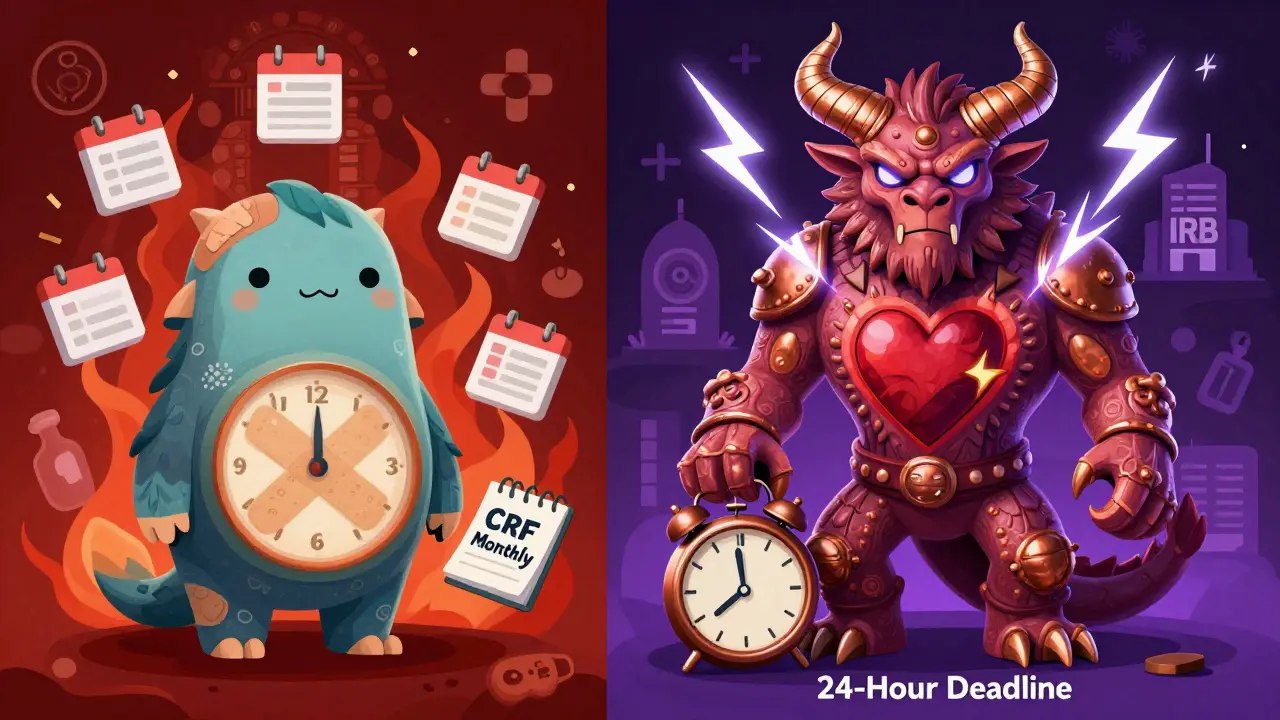
There’s no wiggle room when it comes to serious events. Investigators must report them to the sponsor within 24 hours of learning about them-regardless of whether they think the drug caused it. The clock starts when the investigator becomes aware, not when the lab results come back or when the patient’s family calls.
For non-serious events, reporting follows the protocol. That usually means logging them in the Case Report Form (CRF) and submitting them monthly or quarterly. No rush. No panic. Just accurate documentation.
But the rules don’t stop there. If you’re the sponsor, you have your own deadlines:
- 7 calendar days to report a serious, unexpected event that’s life-threatening
- 15 calendar days for any other serious, unexpected event
And don’t forget the IRB. Serious events must be reported to the IRB within 7 days. Non-serious ones? Often not reported at all-unless the protocol says otherwise. Many IRBs only review non-serious AEs during routine renewals.
The Decision Tree: A Simple Way to Get It Right
NIH’s 2018 guidelines offer a clear, four-question decision tree for determining seriousness. Use it every time:
- Did the event cause death?
- Was the patient at immediate risk of death?
- Did the event require hospitalization or extend an existing stay?
- Did it cause persistent or significant disability or congenital anomaly?
If the answer to any of these is yes-report it as serious. If all answers are no-it’s non-serious. No exceptions. No guesswork.
The FDA’s MedWatch Form 3500A (updated in 2022) includes checkboxes for each of these criteria. Use them. They’re there to keep you honest.
Training and Tools Are Not Optional
ICH E6(R2) says every investigator and study staff member must be trained on seriousness criteria before starting a trial. And it’s not a one-time thing. 98.7% of top research institutions require annual refresher training.
Why? Because mistakes happen. A 2022 survey of 347 research sites found that 63.4% had inconsistent seriousness determinations across different studies-even within the same institution. Hematology and oncology trials had the highest error rates (78.2%), likely because patients already have complex baseline conditions. A drop in hemoglobin? Is that from the drug? Or from the cancer? That’s where training and clear protocols save lives.
Now, technology is helping. AI tools for automatic seriousness classification have improved from 76.3% accuracy in 2020 to 89.7% in 2023. But they’re not replacing humans-they’re supporting them. Final decisions still need a trained eye. The FDA’s 2024 pilot program using natural language processing to triage reports is already showing a 47.3% reduction in processing time in MIT’s tests. That’s not magic. That’s smart design.
What Happens When You Get It Wrong?
Under-reporting serious events can delay safety alerts. A drug might keep being given to patients while a fatal side effect goes unnoticed. Over-reporting non-serious events? That’s just as dangerous. It floods regulators with noise. When every report looks urgent, nothing does.
Deloitte’s 2023 report found that 62.7% of regulatory compliance costs tied to AE reporting come from misclassified non-serious events. That’s over $1 billion a year spent chasing ghosts.
And it’s not just money. It’s trust. When IRBs and regulators see too many false alarms, they start to ignore them. That’s how tragedies happen-not because the system is broken, but because it’s overwhelmed.
What’s Changing in 2025 and Beyond
The rules are getting tighter-and smarter. The EU’s Clinical Trials Regulation, fully active since January 2022, harmonized seriousness definitions across all 27 member states. Cross-border reporting errors dropped by 34.8%.
The FDA’s May 2023 draft guidance proposes tiered reporting timelines within serious events. For example, a life-threatening event might get a 7-day deadline, while a hospitalization that doesn’t threaten life might get 15 days. That’s a step toward precision.
And ICH’s E2B(R4) standard, launching fully in 2025, will make electronic reporting uniform worldwide. No more confusing formats. No more manual data entry errors.
One thing won’t change: the human responsibility. No algorithm can replace a trained investigator who knows the patient, the disease, and the difference between a bad day and a life-changing event.
Bottom Line: Think Outcome, Not Intensity
Don’t report because something feels bad. Report because something happened that changed the patient’s life-or could have ended it.
When in doubt, ask the four questions. Use the checklist. Train your team. Use the tools. And remember: the goal isn’t to report everything. It’s to report the right things-fast, accurately, and without hesitation.
Because in clinical research, the most dangerous mistake isn’t missing a serious event. It’s thinking you saw one when you didn’t-and letting the noise drown out the truth.
Is a severe headache a serious adverse event?
No, a severe headache alone is not a serious adverse event unless it leads to death, life-threatening complications, hospitalization, or permanent disability. Severity (how bad it feels) and seriousness (what outcome occurred) are not the same. A 10/10 headache that resolves with medication is non-serious.
Do I need to report every adverse event to the IRB?
No. Only serious adverse events must be reported to the IRB within 7 days. Non-serious events are typically documented in CRFs and reported during routine reviews unless the study protocol requires otherwise. Always check your protocol and IRB requirements.
What if I’m not sure whether an event is serious?
When in doubt, report it as serious. It’s better to over-report than under-report. But make sure to document your reasoning. Use the NIH four-question decision tree. Consult your safety officer or sponsor. Never guess based on how intense the symptom seems.
Can a non-serious adverse event become serious later?
Yes. If a patient initially reports a moderate rash that later leads to hospitalization due to infection, the event must be reclassified as serious. Always update reports if new information changes the outcome. Timeliness matters-even after initial reporting.
Are psychiatric symptoms like anxiety or depression considered serious?
Only if they meet the outcome criteria: suicidal behavior, hospitalization for psychiatric crisis, or permanent disability. Severe anxiety without hospitalization or risk of self-harm is not serious. Many sites misclassify psychiatric symptoms because they sound intense-but seriousness is about action, not intensity.
What’s the most common mistake in AE reporting?
Confusing severity with seriousness. People report events as serious because they seem intense-like high fever, nausea, or pain. But unless the event caused death, hospitalization, disability, or life-threatening risk, it’s not serious. Training and checklists reduce this error by over 50%.
How do AI tools help with AE classification?
AI tools analyze free-text descriptions in AE reports and flag potential seriousness based on ICH/FDA criteria. They’re now 89.7% accurate-better than human reviewers. But they flag, they don’t decide. A trained reviewer must confirm every classification. AI reduces time spent sorting noise, not replacing judgment.
Do I need to report an event that happened before the trial started?
No. Only events that occur after the patient gives consent and receives the investigational product must be reported. Pre-existing conditions are documented in baseline assessments but are not classified as adverse events unless they worsen during the trial.
What to Do Next
Start with your team. Run a quick training session using the NIH decision tree. Review your last 10 AE reports. How many were misclassified? Fix your CRFs to include checkboxes for the six seriousness criteria. Update your training materials to emphasize outcome over intensity.
If your site doesn’t use an automated AE system, talk to your sponsor about one. The cost of misclassification-time, money, risk-is far higher than the cost of the tool.
And remember: safety reporting isn’t about compliance. It’s about protecting people. Get it right, and you’re not just following rules-you’re saving lives.


